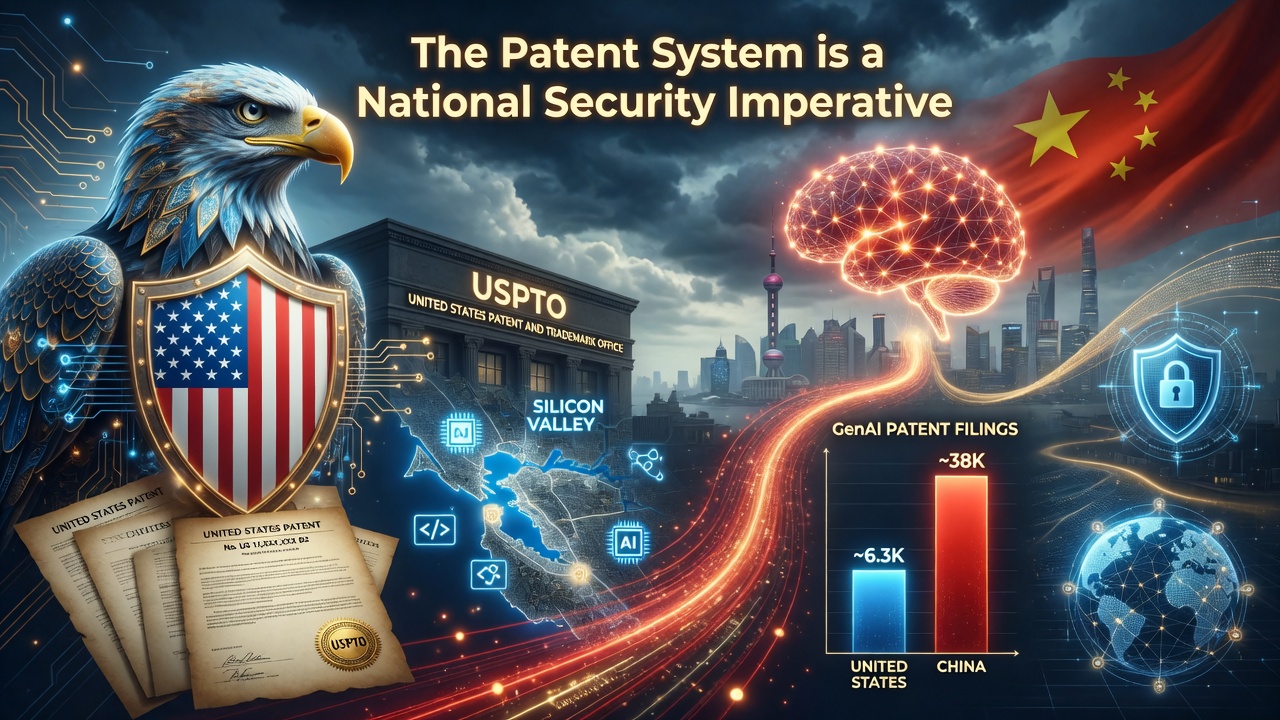
A recent Texas Public Radio discussion with David Martin Davies spotlights a debate policymakers can no longer ignore: as Washington prioritizes America's edge in AI, independent inventors warn that weaknesses in the patent system risk undermining that goal.
Randy Landreneau of U.S. Inventor argues PTAB proceedings have made patents less reliable and more costly for small entities to defend, discouraging the early-stage investment that turns ideas into companies.
The Scale of the Challenge
The scale of the challenge is clear. A WIPO Patent Landscape Report found China-based inventors accounted for more than 38,000 generative AI patent families from 2014 to 2023, roughly six times the U.S. total of about 6,300. Raw filing counts are an imperfect measure of innovation quality, but the trajectory matters: China entered the top 10 of the UN Global Innovation Index in 2025 for the first time. And the NSCAI's 2021 final report warned the U.S. was not prepared to compete in an AI era shaped by China's ambitions, with AI increasingly integrated into military planning and cyber defense.
Bidirectional Stakes on Patent Eligibility
The stakes are bidirectional. Proponents of the Patent Eligibility Restoration Act (PERA) argue Supreme Court decisions have rendered Section 101 eligibility unpredictable, especially for computer-implemented inventions and medical diagnostics. Opponents, including public interest and software groups, caution that expanded eligibility could fuel abusive litigation.
USPTO Response
Under Director John Squires, the USPTO has responded with urgency: the precedential Ex parte Desjardins decision (September 2025) emphasizing technological improvements in machine learning under Enfish, December 2025 guidance on technical evidence and Subject Matter Eligibility Declarations in Section 101 analysis, and a marked increase in PTAB reversals of examiner eligibility rejections.
Federal Circuit and Congress
The Federal Circuit has been more measured. In Rideshare Displays v. Lyft, the court held amended claims ineligible under Alice even with the USPTO intervening in support, and the Supreme Court denied cert in May 2026. PERA (S. 1546) received a Senate IP Subcommittee hearing in October 2025, with markup discussions ongoing.
The gap among USPTO leadership, the Federal Circuit, and Congress will determine whether American AI innovation is protected or exposed. For AI companies and their practitioners, the practical answer lies in the application file: strong specifications, clearly articulated technical improvements, and robust evidentiary records demonstrating real-world advances.
What changes have you noticed prosecuting AI innovations amid these dynamics?