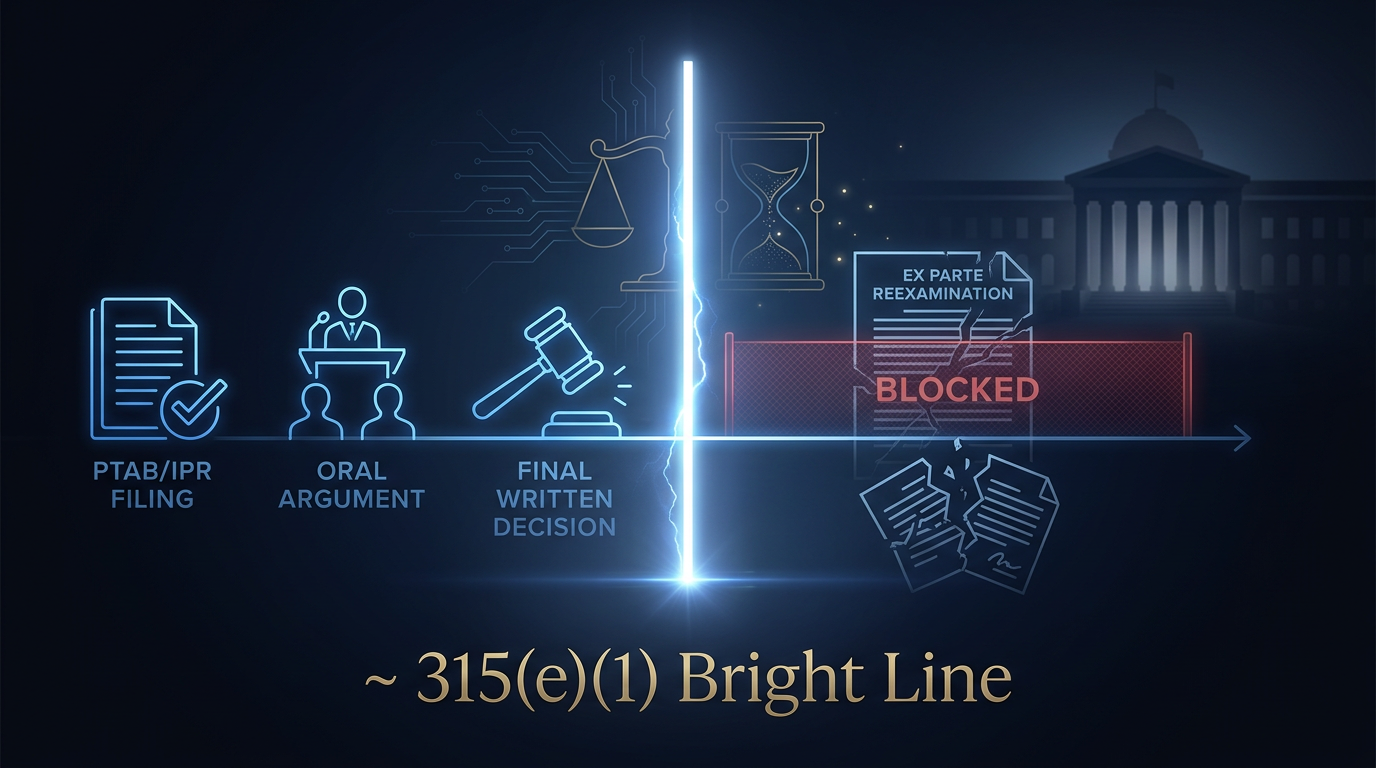
The USPTO just drew a bright line on when § 315(e)(1) estoppel attaches in parallel challenges at the PTAB. Petitioners using “IPR-then-reexam” tactics should take note.
In its April 27, 2026 Decision on Remand (arising from IPR2022-01006), the Office clarified the scope of estoppel for HID Global’s ex parte reexamination request against CPC Patent Technologies’ U.S. Patent No. 9,665,705. The result is unwelcome for those who have gamed the pre-order window.
What Happened
HID filed its reexamination request while the IPR was pending. Four days later—on August 13, 2024—the PTAB issued its Final Written Decision. The Director ordered reexamination on November 4, 2024. CPC (the patent owner) petitioned to vacate. The Office granted that petition on May 27, 2025. On remand, the Office reaffirmed that estoppel had already attached upon issuance of the FWD, rendering the later order improper.
USPTO’s Clarification
The Office now treats the “request” in § 315(e)(1) as a continuing act that spans the entire pre-order period—from filing through the Director’s § 304 determination (the statutory up-to-three-month window). If a Final Written Decision issues anywhere in that interval, estoppel bars the request. A reexamination “proceeding” does not begin until the order issues; before then, the Office is merely evaluating whether to commence one.
Practical Takeaways
- ⚖️ Petitioners can no longer file a reexam request late in an IPR (e.g., after gauging the panel at oral argument) and reliably count on the Director’s order beating the FWD.
- ⏱️ The tactical window has narrowed but remains open—strategists are already shifting reexam filings earlier, often around the oral-argument request deadline (roughly five months before the statutory FWD due date).
- 📋 Front-loading your strongest prior art in the initial IPR petition is now more critical than ever.
- 🔜 HID is expected to challenge the decision under the APA in the Eastern District of Virginia—the same avenue confirmed viable by Alarm.com v. Hirshfeld, 26 F.4th 1348 (Fed. Cir. 2022). A backlog of similar reexam decisions appears to be clearing in the wake of this ruling.
For anyone managing multi-track USPTO strategies, the premium on precise timing and integrated prior-art planning has risen sharply.
Full analysis by Brian Landry & Andrew Schwerin of Saul Ewing LLP on IPWatchdog, Inc: https://lnkd.in/ePjKs_TY