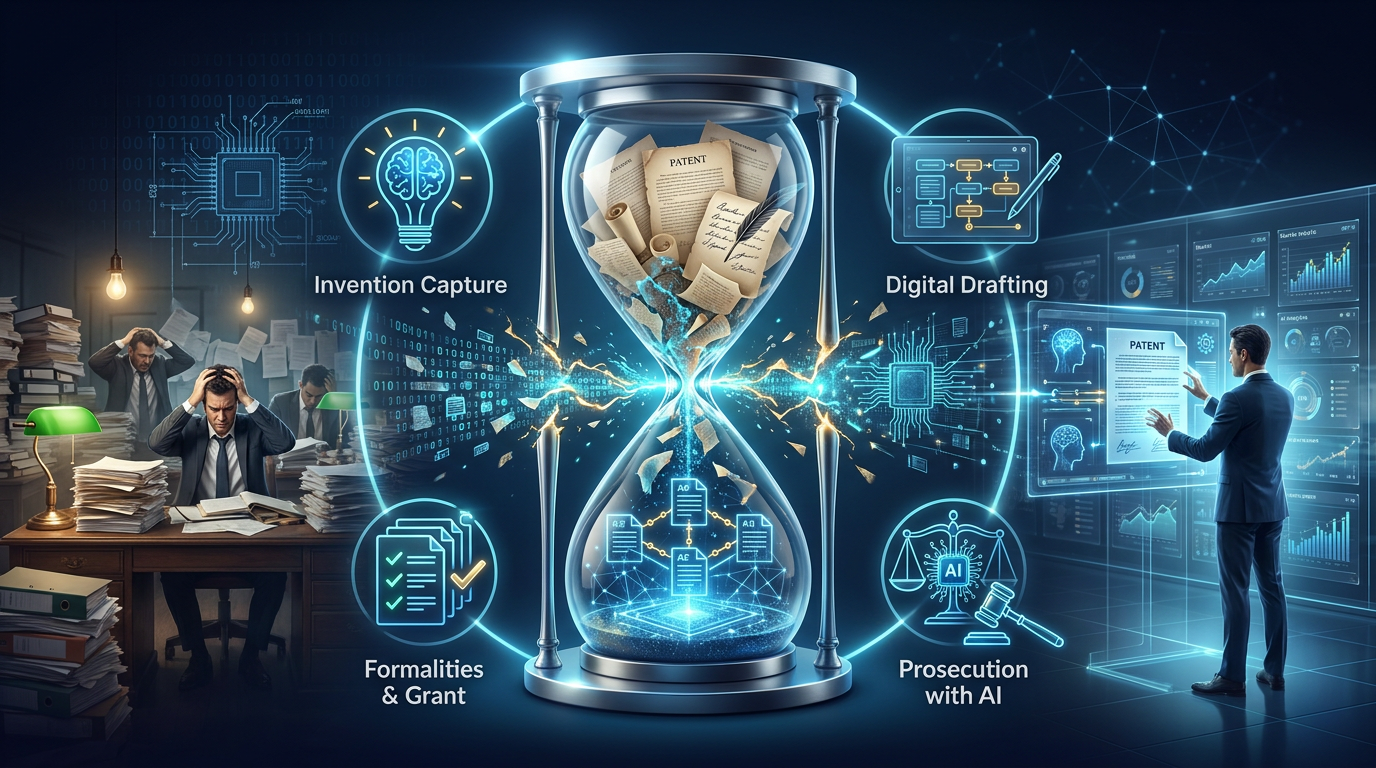
The Billable Hour Is on Borrowed Time.
AI is fundamentally altering patent economics, not merely accelerating tasks. Much of the profession still prices work under legacy assumptions.
Jerome Spaargaren, founder of EIP and a Band 1 patent attorney with over three decades of experience, delivers in The AI Journal a clear and insightful assessment of this shift.
Where the Gains Show Up Across the Patent Lifecycle
When AI restructures the full workflow instead of assisting isolated tasks, the entire cost structure moves. The gains are tangible across the lifecycle:
- Invention capture: AI tools that sit inside or replace the disclosure meeting reduce translation loss and avoid the rework that surfaces weeks later when key questions were never asked.
- Drafting: Specialist patent systems produce genuinely usable first drafts. The attorney shifts from writing to architecting scope and structure. Generalist models may fall short without sufficient direction.
- Prosecution: In a recent moderately complex office action response, AI-assisted claim-to-reference mapping reduced the task from most of a working day to roughly two hours.
- Formalities: Assignments, declarations, powers of attorney, and fee calculations represent the largest aggregate saving—high-volume, rules-based work that AI now handles at scale.
One attorney with strong tooling can now deliver what used to require two or three people. The billable hour made sense when the hour tracked production work. That link has broken, and sophisticated in-house teams have noticed. Procurement conversations are turning pointed.
The Economist reported in March that profits per lawyer at the 100 largest firms have risen 54% since 2019, with rates climbing at more than twice inflation. AI directly undercuts that cost base.
The same pressure hits harder at the other end of the market. Founders priced out of a conventional four- or five-figure provisional are the clients a lower cost structure reaches first.
A New Model: Vibe Patent
That is why Vibe Patent exists: structured disclosure capture, AI-assisted drafting, and registered attorney judgment at the decisions that matter—idea to provisional specification with USPTO filing now for $250. https://vibepatent.ai
The economics have already changed. The question is whether those gains reach the innovators who need them most.
Read more at https://lnkd.in/e7VmRStg.