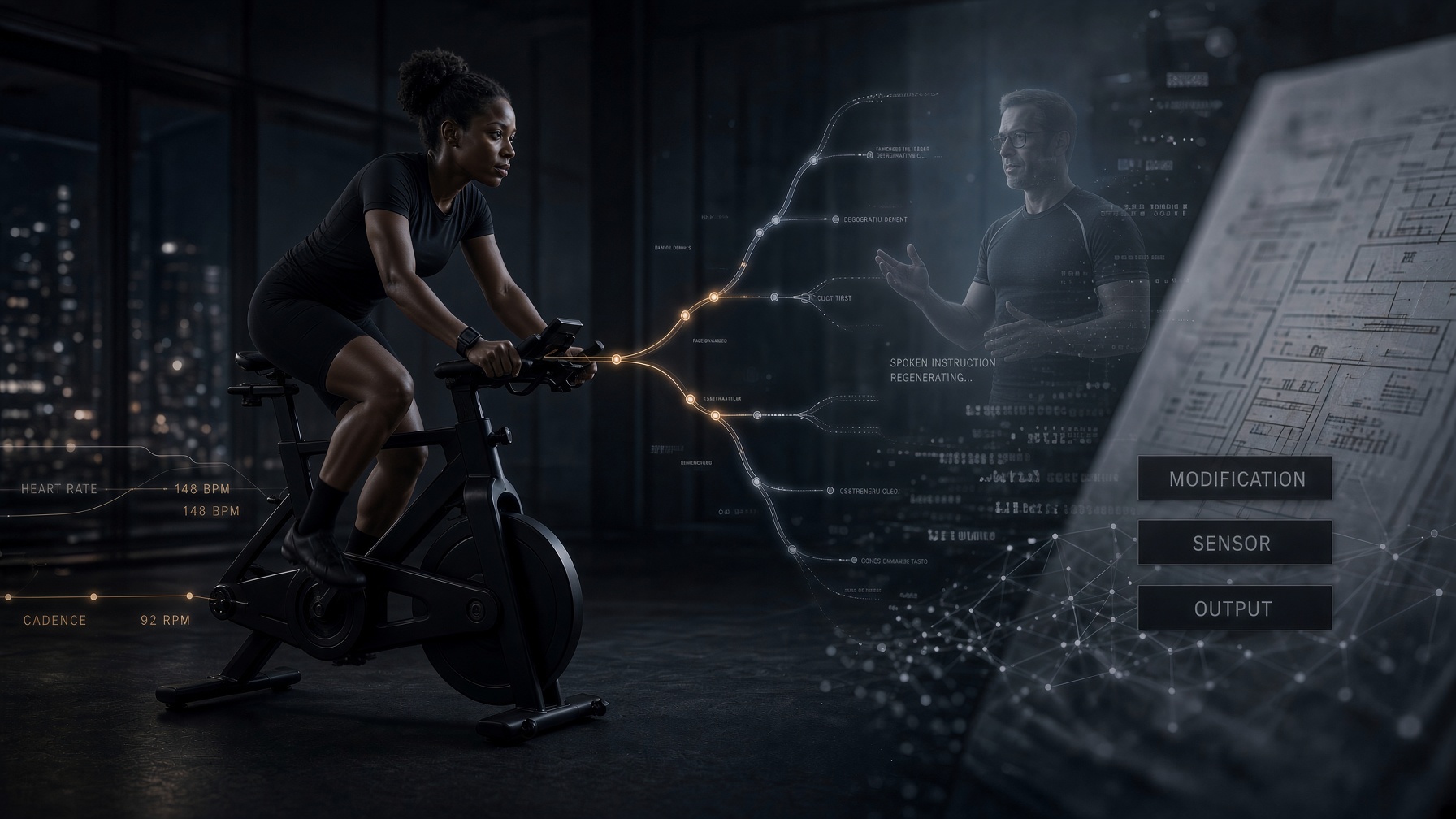
Peloton's two new patent applications describe AI-enabled workout features. But will the claims pass patent eligibility scrutiny?
The USPTO published on August 27, 2026, two patent applications filed by Peloton Interactive Inc. on February 27, 2025. Both share the same specification, which identifies a problem of a workout class whose segments, duration, and sequence are fixed before a user begins, and provides as solution a workout program that branches on live performance data with the coaching audio regenerated to match.
The Claims and Subject Matter Eligibility
- Claim 1 of each application recites three components, a "modification module," a "sensor data module," and an "output module." The workout application generates a modified workout from workout metrics. The audio application modifies a voice instruction from sensor data. Sensor data in, modified output out, using conventional computing parts, is the stereotypical example of an abstract idea.
- In the audio application, claim 2 adds a large language model that generates a modified voice transcript once sensor data misses a threshold, and claim 3 defines that model as "an existing speech synthesis model for the instructor that is trained using exercise classes taught by the instructor." In Recentive Analytics v. Fox, the Federal Circuit held that claims directed to "the application of generic machine learning to new data environments, without disclosing improvements to the machine learning models to be applied," are patent ineligible. Claim 3 supplies a similar description as Recentive in its own words.
- The workout application leaves the model out of its claims. The dependent claims add features like an exercise machine, a wearable device, trigger events and heart rate data. Whether such features make the claims a patent-eligible application of the abstract idea in claim 1 is a close question.
USPTO Guidance vs. Federal Circuit Precedent
Passing examination may not fully resolve the eligibility question. Both the Office and the courts are bound by the same authority, Section 101 as the Supreme Court construed it in Alice and as applied by the Federal Circuit. What has shifted recently is USPTO examination practice. An August 2025 memorandum to the examining corps and the Appeals Review Panel decision in Ex parte Desjardins pushed the Office toward allowing more AI claims. But the Federal Circuit held in In re Rudy that Office guidance "is not, itself, the law of patent eligibility" and "does not carry the force of law," and where the two diverge, the case law controls. That divergence has not yet been addressed in a binding way, so an allowance under current practice predicts less about the ultimate result when the patent is enforced.
Sources
- Read more: Elizabeth Ostertag, Peloton Patents Point to a Future Where AI Workouts Adapt in Real Time, Athletech News (Sept. 3, 2026):
- https://athletechnews.com/peloton-patents-point-to-a-future-where-ai-workouts-adapt-in-real-time/
- The workout application: Real-Time Modification of Workouts Within a Connected Fitness Platform, U.S. Pub. No. 2026/0249137, Appl. No. 19/065,891, filed Feb. 27, 2025:
- https://patents.justia.com/patent/20260249137
- The audio application: Real-Time Modification of Audio Content for a Virtual Coach Application, U.S. Pub. No. 2026/0249138, Appl. No. 19/065,908, filed Feb. 27, 2025:
- https://patents.justia.com/patent/20260249138
- Recentive Analytics, Inc. v. Fox Corp., 134 F.4th 1205, 1216 (Fed. Cir. 2025), cert. denied (Dec. 8, 2025):
- https://www.courtlistener.com/opinion/10381132/recentive-analytics-inc-v-fox-corp/