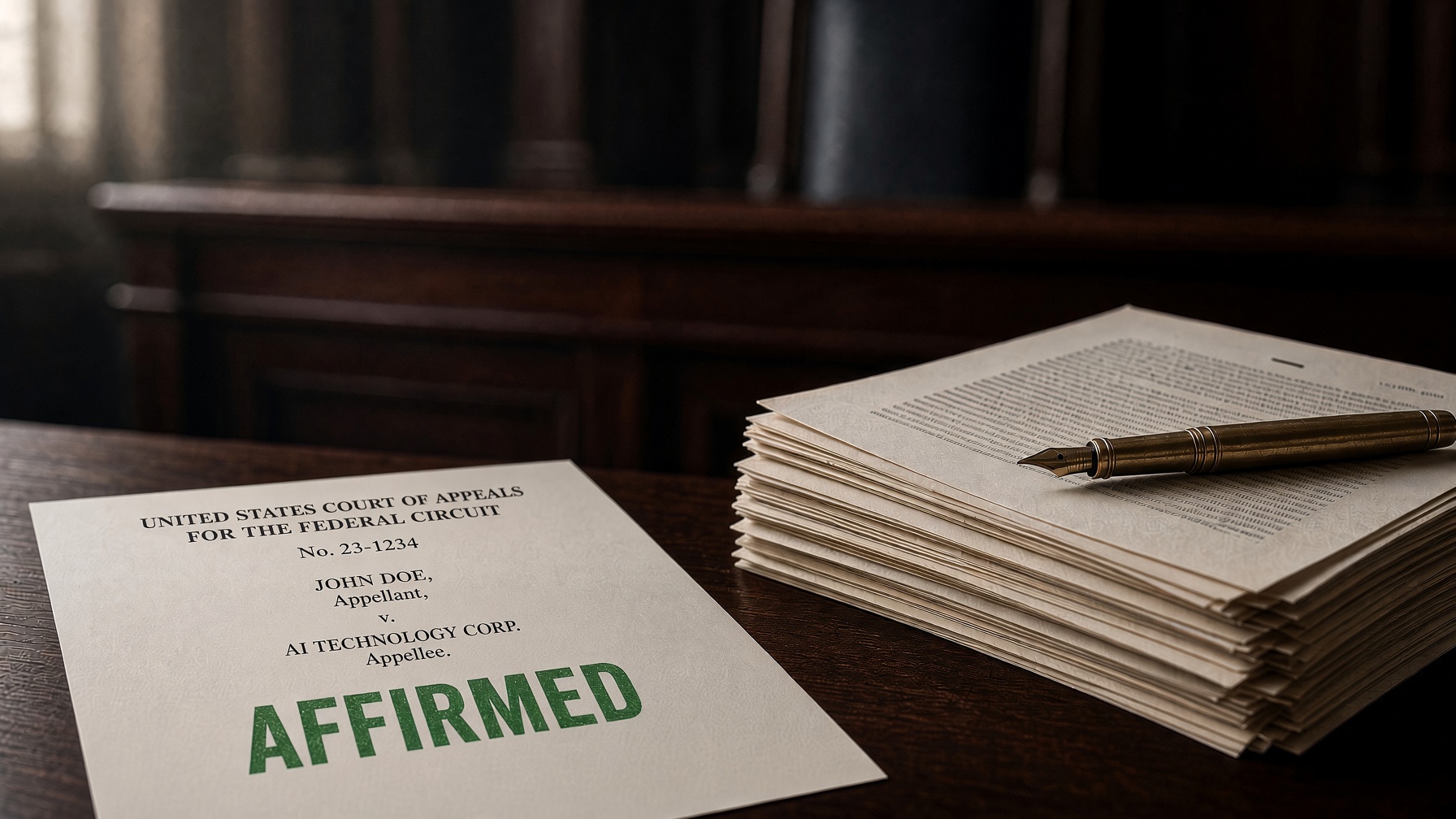
The Federal Circuit is issuing fewer one-word affirmances and writing more short opinions instead, giving losing appellants more ammo.
Bloomberg Law's Michael Shapiro documented a new Federal Circuit trend. The court issued 94 Federal Circuit Rule 36 judgments in 2025, the single-word "affirmed" dispositions that provide no reasons. This was the first year such one-word judgments fell below 100 since 2007. Nonprecedential opinions climbed across the same period: 295 in 2023, 329 in 2024, 469 in 2025. The court has not stopped using Rule 36, and 2026 is tracking only a modestly smaller total.
Certiorari Petitions Challenging Silent Dispositions
Two cert petitions drove the criticism, on different theories. Section 144 directs the Federal Circuit to "issue to the Director its mandate and opinion" in appeals from the PTAB. ParkerVision argued that "opinion" is a term of art requiring stated reasoning that a one-word affirmance cannot supply. Island Intellectual Property, appealing from district court where Section 144 does not apply, argued that the absence of a written opinion left it "impossible for Petitioner, the public, or this Court on appeal to understand the reasons." The Supreme Court denied both petitions.
Impacts for Patent Practice
- Citable Authority: Federal Circuit Rule 32.1 permits citation of nonprecedential dispositions. A Rule 36 judgment leaves nothing citable at all. Converting silent affirmances into short written opinions builds new persuasive authority.
- Substantive Visibility: More written dispositions mean more visibility into how the court applies legal precedents like Alice and Recentive to machine-learning claims, the same doctrinal space the USPTO has been widening from the agency side through Ex parte Desjardins and the revised MPEP § 2106 guidance.
- Appellate Ammo: Losing parties gain a basis for evaluating en banc or certiorari review. Knowing which arguments failed is a real upgrade over silence.
A Discretionary Practice Shift
Fish & Richardson's Oliver Richards suspects the shift is "responsive to those various cert petitions." Charley Macedo, counsel for Island Intellectual Property, made the broader point: "Supreme Court petitions, even if they don't succeed, they do influence the law."
Not everyone counts the change as progress. Chicago-Kent's Greg Reilly, a self-described rare supporter of Rule 36, notes the rule exists "to deal quickly and efficiently with those types of cases where there is nothing useful for the appellate court to say."
As a formal matter, Rule 36 remains unchanged. The Supreme Court left it in place, and the Federal Circuit has not amended it or explained the shift. What has changed is discretionary practice, which can revert at any time.
Sources
- Michael Shapiro, "Federal Circuit Writing More After Critique of One-Word Rulings," Bloomberg Law: https://news.bloomberglaw.com/ip-law/federal-circuit-writing-more-after-critique-of-one-word-rulings
- ParkerVision, Inc. v. TCL Industries Holdings Co., No. 24-518 (U.S.), cert. denied Mar. 24, 2025
- Island Intellectual Property LLC v. TD Ameritrade, Inc., No. 24-461 (U.S.), cert. denied Mar. 24, 2025
- 35 U.S.C. § 144
- Fed. Cir. R. 32.1; Fed. Cir. R. 36
- Ex parte Desjardins, Appeal No. 2024-000567 (ARP Sept. 26, 2025) (precedential); MPEP § 2106
- Recentive Analytics, Inc. v. Fox Corp., 134 F.4th 1205 (Fed. Cir. 2025), cert. denied, No. 25-505 (U.S. Dec. 8, 2025)