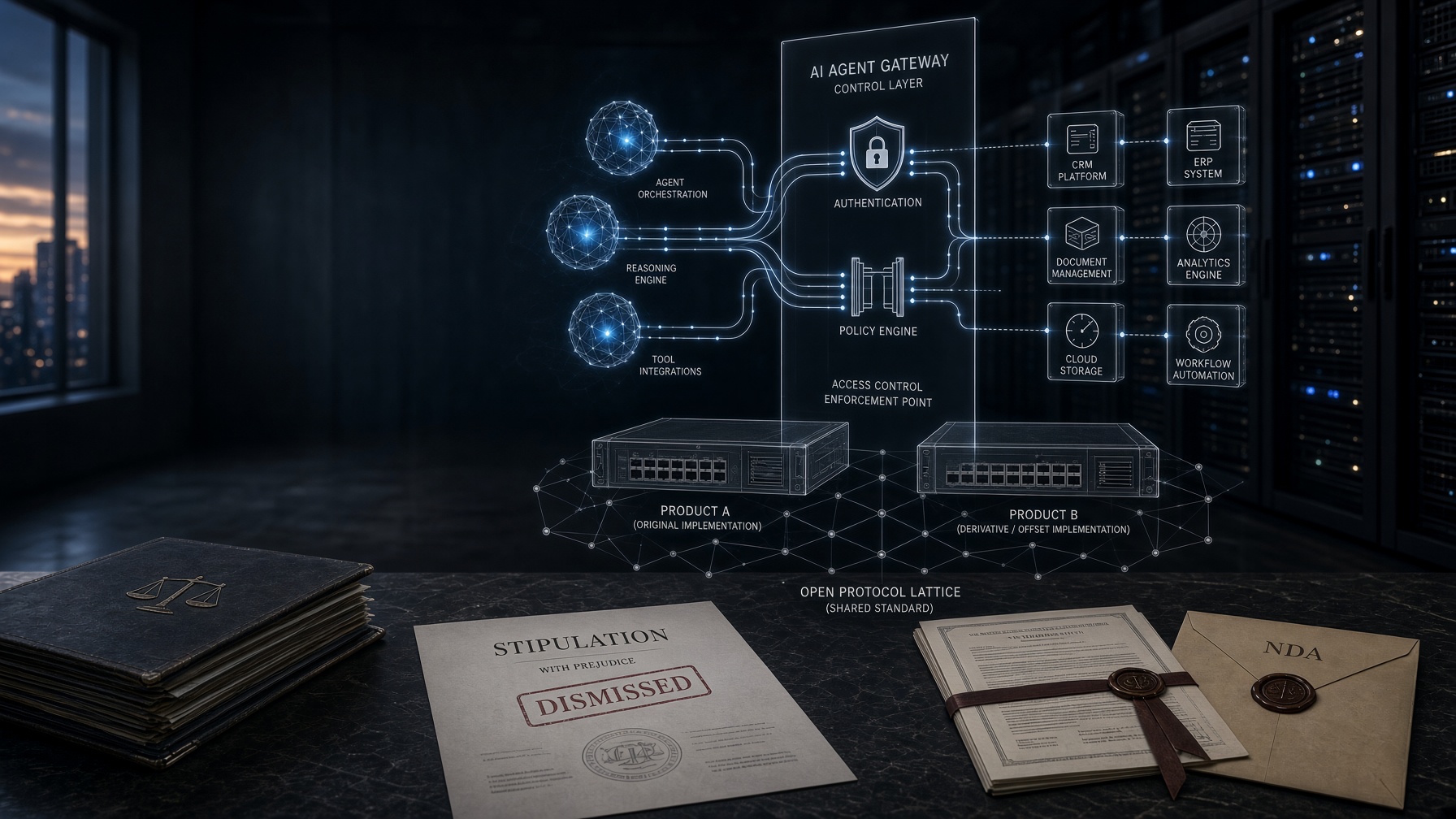
Runlayer accused Rippling of using its source code and product roadmap to build a copy, then walked away from the case empty-handed.
Runlayer (Anysource, Inc.), an AI infrastructure startup, sued HR software company Rippling (People Center, Inc.) in the Southern District of New York on July 28, 2026, alleging trade secret misappropriation, breach of contract, and unfair competition. Runlayer's product is a Model Context Protocol (MCP) gateway sitting between AI agents and enterprise systems, enforcing authentication and access policy. Under an NDA and a trial agreement barring copying and derivative works, Runlayer shared source code, roadmap, and deployment architecture during a year-long paid evaluation. After pricing talks collapsed, a person the complaint describes as a Rippling insider told Runlayer's CEO an internal project was "almost a 1 to 1 copy of Runlayer." Rippling called the claims fabricated.
On August 10, Rippling countersued in Delaware, asserting U.S. Patent Nos. 11,435,994; 12,032,940; and 11,789,941 against Runlayer's gateway and alleging willfulness.
On August 19, Judge Denise Cote denied Runlayer's letter motions to compel expedited discovery. A joint stipulation filed the same day dismissed both actions with prejudice, along with a co-pending arbitration. No compensation was paid, each side bearing its own fees.
Why This Matters
- Ownership of products built on top of an open protocol is still undecided. Runlayer alleged Rippling knew its evaluation-only access barred copying, then used the material to build a competing platform. No court reached whether deployment architecture layered on MCP is protectable, so future licensors face similar uncertainty.
- Second Circuit law asks who was given access and what those people were bound to do. In Turret Labs v. CargoSprint, a federal trade secret claim failed because the licensor never alleged confidentiality obligations binding the users able to see the software's functionality. Access without obligation undermines a claim of trade secret misappropriation.
- Remedy timing can outweigh the merits. Runlayer sought expedited discovery and an injunction in aid of arbitration, leaving damages to the arbitrator. Refused the discovery, Runlayer dismissed the same day, arbitration included.
- Rippling built leverage years earlier. Those patents issued in 2022, 2023, and 2024 on organizational data integration and synchronization, before any MCP gateway market existed. A company holding only trade secrets has less leverage against a competitor with patents.
Rippling launched a competing MCP gateway shortly after the dismissals. A year of evaluation access, an NDA, and a covenant against copying produced no remedy for Runlayer.
Sources
- Read more: Blake Brittain, Reuters (July 28, 2026), https://www.reuters.com/default/ai-startup-runlayer-sues-hr-technology-firm-rippling-allegedly-stealing-trade-2026-07-28/
- Countersuit: TechCrunch (Aug. 10, 2026), https://techcrunch.com/2026/08/10/now-rippling-is-counter-suing-tiny-startup-runlayer/
- Dismissal: TechCrunch (Aug. 20, 2026), https://techcrunch.com/2026/08/20/runlayer-rippling-drop-lawsuits-but-the-brouhaha-is-still-a-cautionary-tale-for-founders/
- Dockets: Anysource, Inc. v. People Center, Inc., No. 1:26-cv-06410 (S.D.N.Y.), https://www.courtlistener.com/docket/73680513/anysource-inc-v-people-center-inc/
- People Center, Inc. v. Anysource, Inc., No. 1:26-cv-01007 (D. Del.), https://www.courtlistener.com/docket/73741871/people-center-inc-v-anysource-inc/