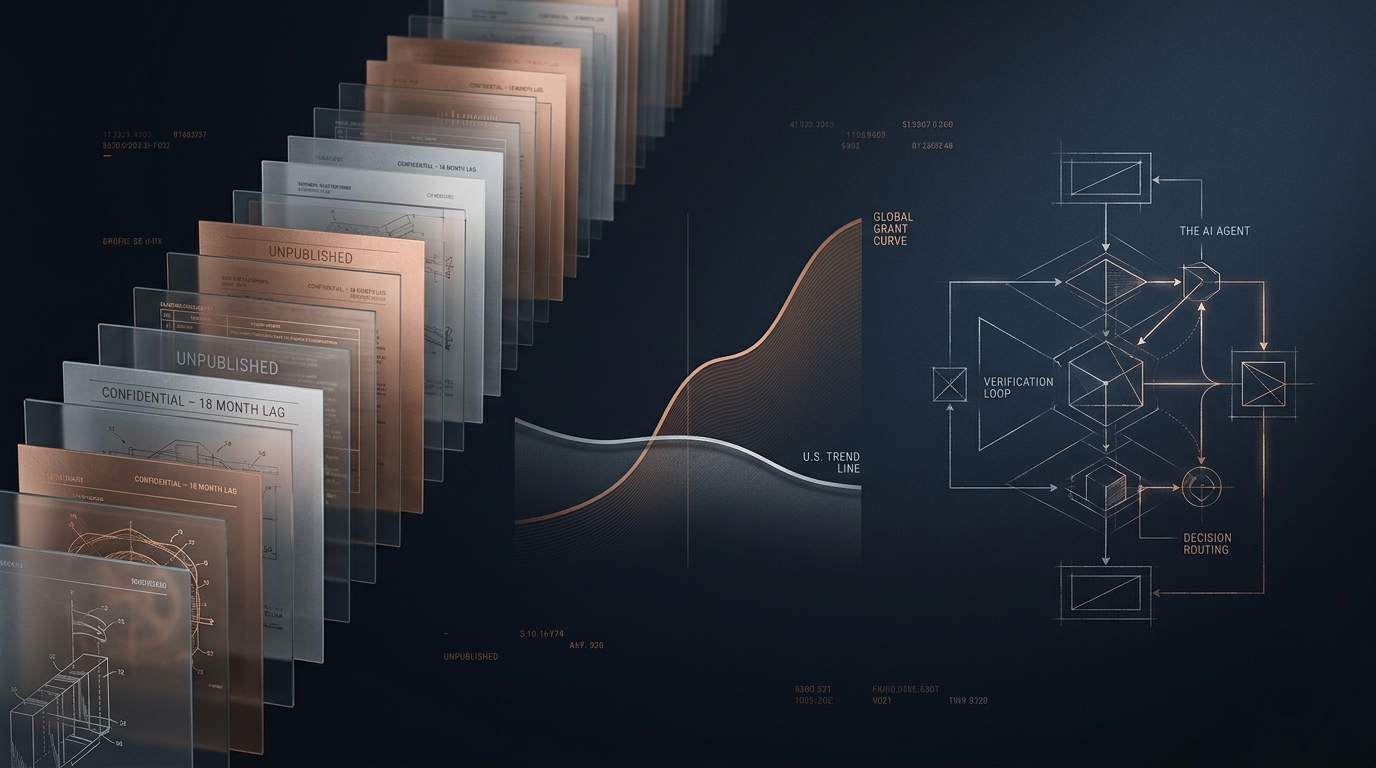
Global AI patent grants crossed 100,000 in a single year for the first time. Worldwide grants are up 83% over three years, while U.S. AI grants fell about 7% from their 2023 level.
Key Findings from the Inventing AI Report
IFI CLAIMS Patent Services released its Inventing AI report on July 28. Worldwide AI grants reached 107,279 in 2025. Of 209,518 AI applications filed globally last year, 23% related to generative AI and 9% to agentic AI, up from 5% in IFI's prior study. In the U.S., the agentic share is far higher: generative AI accounted for 16% of 2025 applications and agentic AI for 15%, up from 7%.
The decline sits outside the AI-native categories. U.S. generative AI grants rose 11% year over year, and agentic AI grants rose 14% year over year and 70% since 2021. The U.S. portfolio is shifting toward those categories even as its total shrinks.
Applicant Rankings by Category
The applicant rankings reorder by category, and incumbents hold every top spot.
- Samsung led worldwide AI applications with 2,162, then Huawei at 1,822 and Google at 1,672
- Google ranked first in generative AI applications, both in the U.S. and worldwide
- Nvidia led agentic AI with 128 U.S. filings, ahead of Microsoft at 112 and Google at 91. Worldwide the three nearly tie: Nvidia 225, Google 222, Microsoft 217
- OpenAI filed 27 U.S. applications and 35 worldwide. Anthropic filed 7 and 8. DeepSeek and xAI held none anywhere
IFI defines "agentic AI" through its own keyword and CPC search and has not published that list.
The Filing Surge Runs Into Legal Constraints
A crowded field still has to clear § 101. Recentive Analytics v. Fox, 134 F.4th 1205 (Fed. Cir. 2025), holds that applying generic machine learning to a new data environment, without disclosing a technical improvement, e.g., to the model, is abstract. An agent applied to a field of use is the same problem. A disclosed improvement in orchestration, routing, or verification is the path that survives.
The agency and the courts have moved in opposite directions. The August 2025 examiner memorandum and the precedential designation of Ex parte Desjardins made allowance easier at the Office. Neither binds a district judge. An agentic AI patent is easier to obtain in 2026 than in 2024 and no easier to enforce.
Trade secrecy carries its own risk of loss. In Trinidad v. OpenAI, 2026 WL 21791 (N.D. Cal. Jan. 5, 2026), disclosure of proprietary frameworks to a consumer-tier platform under no confidentiality duty defeated the reasonable-measures element of 18 U.S.C. § 1839(3)(A).
Applications publish 18 months after the earliest priority date, and under 35 U.S.C. § 102(a)(2) and (d)(2), prior art attaches at that effective filing date, not at publication. What will be cited against a 2026 agentic application is already dated and largely still unpublished.
Sources
- IFI CLAIMS Patent Services & IALE, IFI Insights: Inventing AI (July 28, 2026)
- IPWatchdog, Inc. coverage (July 29, 2026)
- Recentive Analytics v. Fox, 134 F.4th 1205 (Fed. Cir. 2025)
- Ex parte Desjardins, Appeal No. 2024-000567 (ARP Sept. 26, 2025), designated precedential Nov. 4, 2025
- USPTO § 101 memorandum (Aug. 4, 2025)
- Trinidad v. OpenAI, Inc., 2026 WL 21791 (N.D. Cal. Jan. 5, 2026)