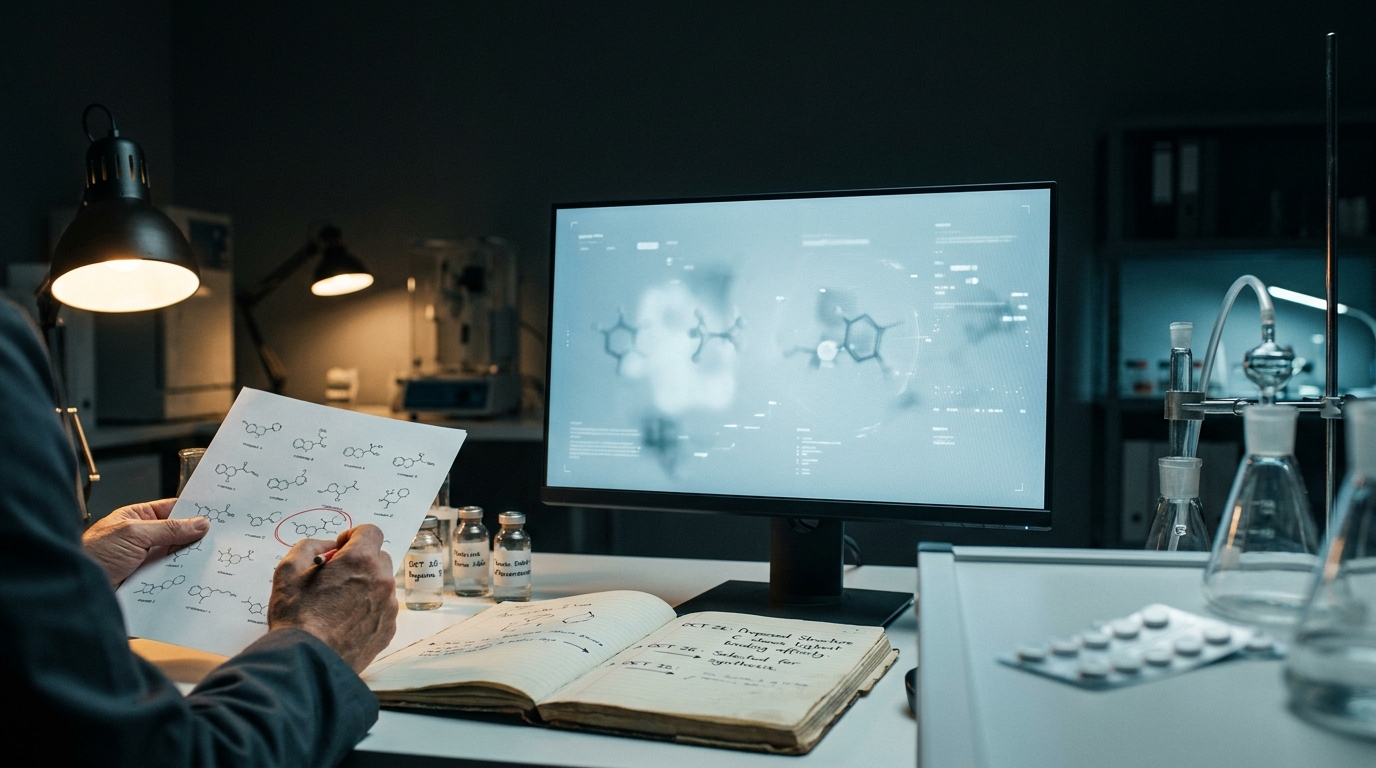
Crediting an AI with a discovery invites challenges about which humans conceived it.
Insilico Medicine credited its generative AI with discovering a pulmonary fibrosis drug, then filed the patent naming five humans, including the CEO.
The Legal Standard for AI Inventorship
The legal principles surrounding AI inventorship are established, but the practical applications are not fully settled.
Only humans can be inventors. The Federal Circuit so held in Thaler v. Vidal (2022), and the USPTO’s revised guidance of November 28, 2025 treats AI as a tool.
That guidance rescinded the 2024 practice of measuring an AI's contribution against the Pannu factors, the test for whether a person qualifies as a joint inventor. A machine is not a person. The test for AI-assisted work is ordinary conception: whether a natural person formed a definite and permanent idea of the complete invention.
Conception vs. Reduction to Practice
Insilico's CEO told MIT Technology Review's Antonio Regalado that human chemists synthesize the compounds, make the variants, and run the animal studies, and that "someone will still push the button and give the budget." Synthesis and lab tests are typically part of reduction to practice, the building and testing of an idea someone already had. Budget and management are generally not conception activities. Under Burroughs Wellcome, conception is the touchstone of inventorship, and completing another person's idea in the lab, without more, does not make the completer an inventor.
Section 256 of the Patent Act lets a patent owner correct who is named as an inventor. Fortress Iron v. Digger Specialties (Fed. Cir. Apr. 2, 2026) is not an AI case, but it highlights applicable limits. An omitted inventor who cannot be notified cannot be joined, and the claims fall with the defect.
Named inventors are presumed correct, and simply using a tool, like AI, does not disqualify the human operator as an inventor. The vulnerability is incorrect inventorship, whether the patent names someone who did not conceive or omits someone who did. A development record documents activity, but not necessarily conception.
Ryan Abbott, who litigated the test cases seeking to name an AI as inventor, put the harder question to Regalado: "What if I asked Claude to cure cancer, and it did? I think it would be inappropriate to claim that I invented that."
Practice Points
- Inventorship documentation, while not required to get a patent from the USPTO, matters if and when the patent is litigated. Current rules do not require disclosure of AI use.
- Record contemporaneously who framed the problem, who set the constraints, who supplied or modified inputs to an AI tool, and who selected among the outputs and why.
- Avoid naming executives or managers whose contributions were limited to budget and oversight.
Sources
- Antonio Regalado, When AI designs a drug, who gets the credit?, MIT Technology Review (Aug. 21, 2026)
- https://www.technologyreview.com/2026/08/21/1142627/when-ai-designs-a-drug-who-gets-the-credit/
- Revised Inventorship Guidance for AI-Assisted Inventions, 90 Fed. Reg. 54636 (Nov. 28, 2025)
- https://www.federalregister.gov/documents/2025/11/28/2025-21457/revised-inventorship-guidance-for-ai-assisted-inventions
- Thaler v. Vidal, 43 F.4th 1207 (Fed. Cir. 2022)
- Thaler v Comptroller-General of Patents, Designs and Trade Marks [2023] UKSC 49 (20 Dec. 2023)
- Pannu v. Iolab Corp., 155 F.3d 1344 (Fed. Cir. 1998)
- Burroughs Wellcome Co. v. Barr Labs., Inc., 40 F.3d 1223 (Fed. Cir. 1994)
- Fortress Iron, LP v. Digger Specialties, Inc., No. 24-2313 (Fed. Cir. Apr. 2, 2026)
- https://www.courtlistener.com/opinion/10831830/fortress-iron-lp-v-digger-specialties-inc/