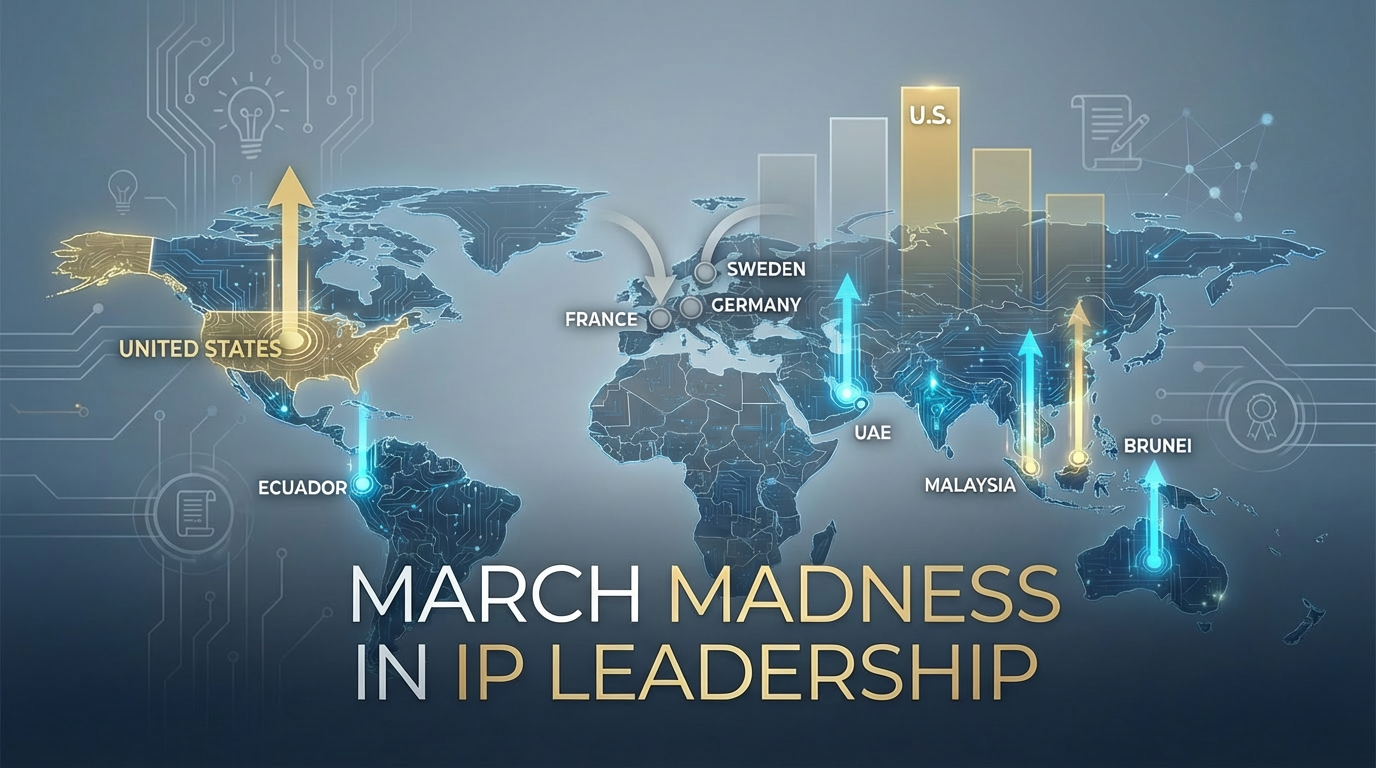
The U.S. Chamber's Global Innovation Policy Center released its 14th annual International IP Index, benchmarking IP systems in 55 economies across 53 criteria covering patents, copyrights, trademarks, enforcement, trade secrets, commercialization, and incentives for cutting-edge innovation. The headline finding should concern AI patent stakeholders: several leading economies are weakening IP protections precisely when strong frameworks are vital for rapid innovation.
The U.S. ranks first at 95.15%. But concerns emerge beneath the top line.
- 📉 Scores declined in eight EU Member States (including France, Germany, Sweden, and the Netherlands), concentrated among high-income economies that have historically set global IP standards—classic top seeds faltering.
- 🔒 China ranks 25th; despite commitments under the 2020 U.S.-China Phase One Economic and Trade Agreement, rights holders still face obstacles on patent term restoration (tied to first global launch), enforcement, and supplemental data acceptance.
- ⚠️ 27 economies showed little or no improvement—raising concerns about a global drift toward weaker IP norms.
- 🌍 Bright spots in emerging markets: the UAE (+4.72%), Ecuador (+2.81%), Malaysia (+1.42%), and Brunei (+1.42%) posted the largest increases, driven by targeted reforms—true Cinderella stories.
For patent practitioners and innovators in AI and life sciences, two findings stand out.
First, the Index flags that the rapid expansion of broad AI-related policies is creating new ambiguities for rights holders and AI developers alike. As AI patent filings surge globally, the jurisdictions where those patents will be meaningfully enforceable is becoming a core strategic question. Companies may want to renew scrutiny of the business aspects of filing strategy, prioritizing clear enforcement environments.
Second, the life sciences section is a clear warning for biopharma clients. The EU's General Pharmaceutical Legislation (including its expansion of the Bolar exemption to commercial activities, which undermines patent enforcement), China's first-global-launch requirement for patent term restoration, and U.S. proposals to expand march-in rights are all moving in the same direction—threatening investment and competitiveness at a time when life sciences innovation is critical. These trends underscore the need for diversified global strategies to safeguard R&D incentives and maintain competitive edges in key markets.
Read the full report from U.S. Chamber of Commerce: https://lnkd.in/eCS4YwNj