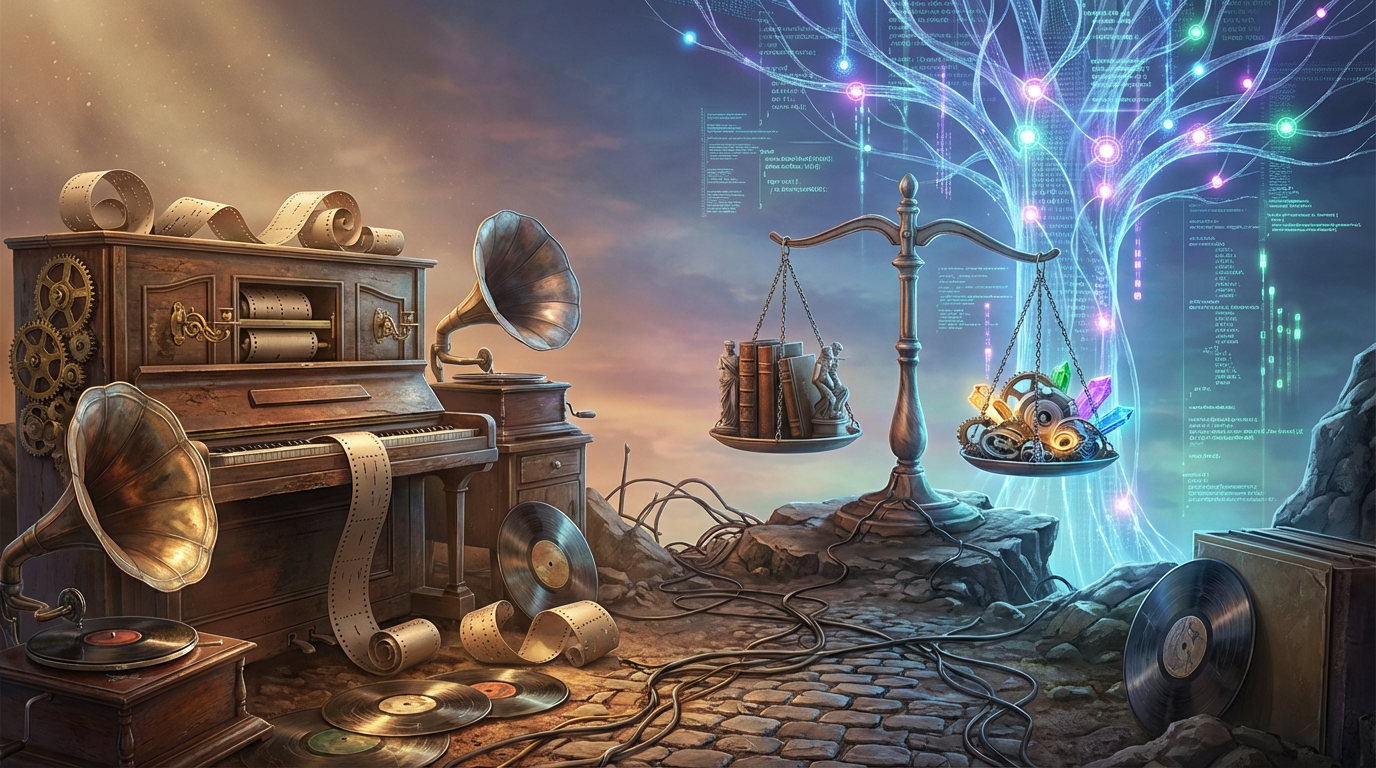
Last week I attended the Intellectual Property, Media and Entertainment Law Journal (IPLJ) Symposium at Fordham University School of Law, where legal historian Dr. Douglas Lind presented his article co-authored with Adrienne Holz: From Player Piano to Generative AI: Artificial Expression and the Law of Copyright.
The article parallels current copyright challenges posed by generative AI with similar ones faced in the late 19th and 20th centuries with emerging music reproduction technologies like the player piano and phonograph.
Historical Missteps
Courts treated these technologies as "mere mechanics" rather than expressions of human creativity (e.g., White-Smith Supreme Court case in 1908). The result:
- Copyright law lagged behind reality, creating a period of "disequilibrium"
- Creative works were left vulnerable to misappropriation and piracy (e.g., 1950s-era "disklegging")
The 1909 Copyright Act added compulsory licensing but denied protection to rolls and records, undervaluing artistry.
AI Today
- Content creators allege training AI involves copying, and training itself is a form of reproduction
- Near-verbatim outputs are real legal concerns, not hypothetical
Key Lesson: When copyright reduces new forms of creative expression to "mere mechanics," it under-protects authors and artists. The law should thus focus on human creative "inputs" over mechanical "outputs" to avoid repeating mistakes.
Fair Use in AI Training
The article favors restricting fair use for AI training, arguing the doctrine "must be carefully circumscribed" to avoid under-protection and enable piracy and market harm, assessing the fair use factors as follows:
- Purpose: Often commercial and non-transformative, "feeding off misappropriated data"
- Amount: Ingests entire works and vast datasets as reproduction
- Market: Outputs substitute originals and foreclose licensing
LLM providers counter that training is transformative use, extracting patterns for new creations (e.g., Kadrey v. Meta win per Campbell v. Acuff-Rose).
The article argues that to avoid repeating historical mistakes, copyright law should ensure human creators receive control or fair compensation (e.g., through compulsory licensing) when their works are used to train generative AI.
Lessons for Founders & AI Companies
- Legal uncertainty is not legal immunity
- Classification choices can shape entire markets for decades
- Under-protection today can become systemic risk tomorrow
- Proactive efforts to ensure training data is properly licensed remains the safest bet
Read the full article here: From Player Piano to Generative AI: Artificial Expression and the Law of Copyright