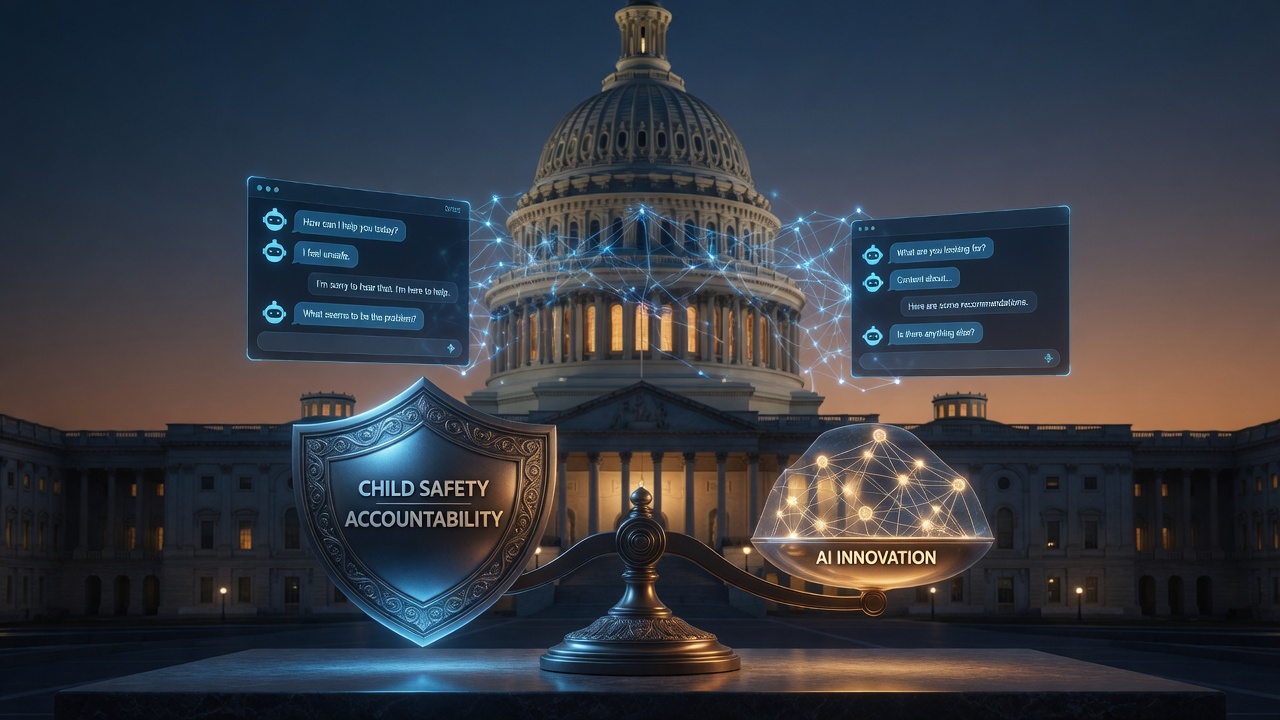
Sens. John Curtis (R-UT) and Adam Schiff (D-CA) introduced the Safeguarding AI Features to Ensure Kids' Informed Digital Safety (SAFE KIDS) Act, S. 4855, on June 23. The bill applies to any provider making an "AI chatbot" available to minors in the U.S., broadly defined to cover adaptive, open-ended conversational systems, with carve-outs for narrow customer-service and enterprise tools.
Key Provisions
- Pre-launch risk assessments and a public child safety policy before minors can access the chatbot
- A ban on chatbot outputs designed to create false impressions of sentience or foster inappropriate emotional dependence, isolation, or role-played relationships with a child
- A ban on child sexual abuse material, including sexual deepfakes
- Documented crisis-response protocols, including parental notification when a child faces imminent risk of suicide or self-harm
- Independent annual audits, plus bans on child-targeted behavioral advertising and sale of children's data without verifiable parental consent
- FTC enforcement as an unfair-or-deceptive-practice violation, civil penalties up to $10,000 per violation, and a savings clause preserving stricter state laws. No private right of action.
The House's Competing Approach
Six days later, the House passed its own package, the Kids Internet and Digital Safety Act (KIDS Act, H.R. 7757), 267-117. Its Section 213 states plainly that nothing in its harm-mitigation provisions "may be construed to… impose a duty of care" — the legal standard that would require platforms to actively prevent foreseeable harm to kids, not just disclose risks after the fact.
The House's exclusion of a duty of care raises a dispute between the two chambers. Sens. Marsha Blackburn (R-TN) and Richard Blumenthal (D-CT), the bipartisan authors of the Senate's Kids Online Safety Act, responded jointly that the House bill is "a pale imitation of Big Tech accountability."
Where Child Safety Meets AI Overregulation
The deeper question is where child safety regulation ends and overregulation of AI begins. Supporters see a duty of care as common-sense accountability for design-driven harm. Critics counter that an open-ended "foreseeable harm" standard invites inconsistent, politically driven enforcement and chills the innovation that makes these tools valuable. Well-defined obligations like those in both bills protect kids without asking companies to guess what a regulator will later call harmful.
The practical takeaway holds either way: risk assessments, independent audits, and documented crisis protocols appear in every version of this legislation, making them sound investments no matter which philosophy prevails in conference.
Sources
- Bloomberg Law: Senators Unveil Bipartisan Bill to Protect Kids From AI Chatbots
- S. 4855: congress.gov/bill/119th-congress/senate-bill/4855
- H.R. 7757: congress.gov/bill/119th-congress/house-bill/7757
- Blackburn-Blumenthal statement: blackburn.senate.gov/2026/6/blackburn-blumenthal-statement-on-house-passage-of-the-kids-act