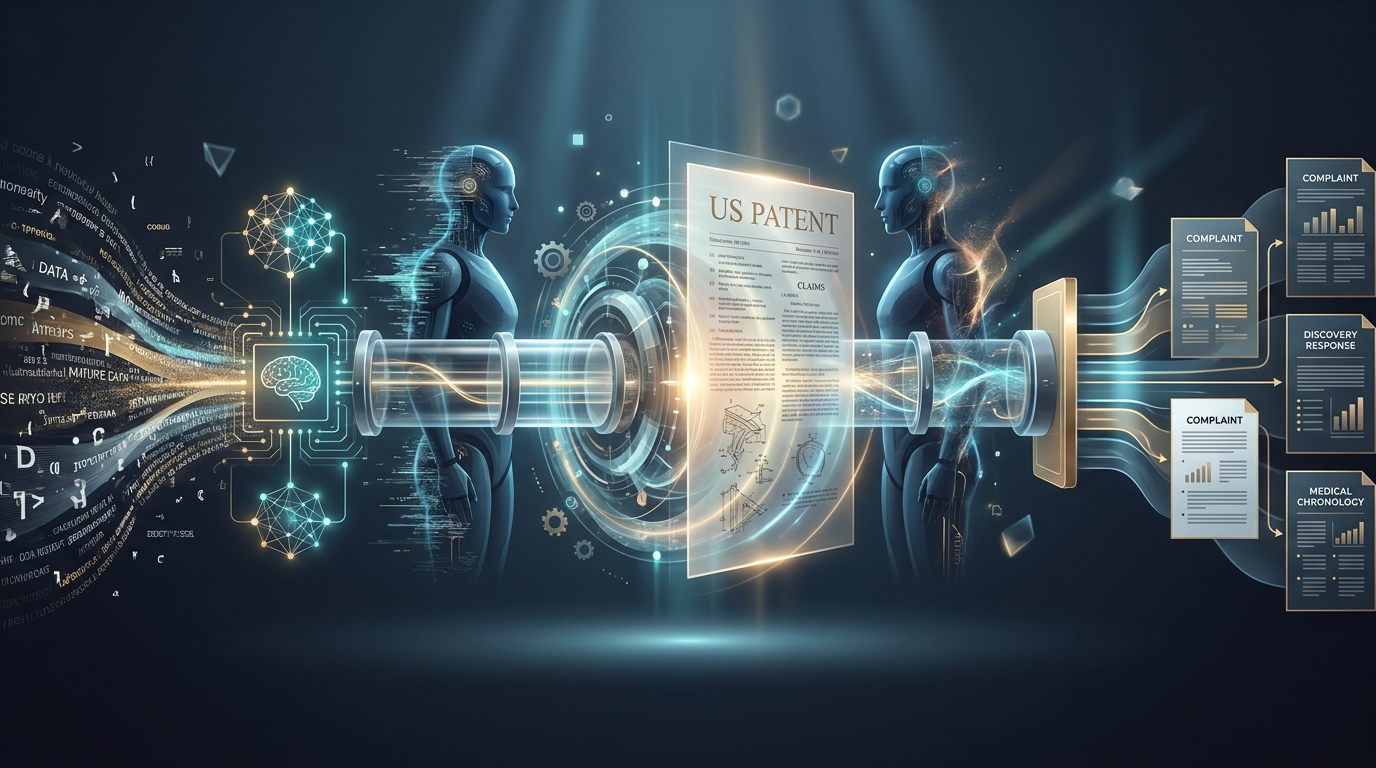
On June 17, 2026, Ohio-based AI.Law sued competitor Eve Legal (Butler Labs Inc.) in the Northern District of California, asserting U.S. Patent No. 12,461,932, "Method and System for Transforming Data Using Artificial Intelligence to Generate Content."
The patent is directed to AI methods for transforming unstructured data into properly formatted legal documents, including complaints, discovery responses, and medical chronologies. AI.Law alleges Eve's platform performs this workflow and had pre-suit notice as early as May 2026.
Eve reached a $1B+ valuation after its 2025 Series B (Spark Capital, Andreessen Horowitz, and others). AI.Law offers more than 30 AI-powered legal drafting tools. This appears to be one of the first reported competitor-versus-competitor patent suits in the fast-growing legal AI sector, a sign the space has moved from land-grab growth into a phase where IP boundaries get tested in court.
Three Things Stand Out
- Claim construction will matter well beyond this case. A broad claim construction covering any ingest-prompt-generate-format pipeline, if it survives Section 101 and prior art challenges, could give AI.Law leverage across the sector and invite similar assertions against other players. A narrower construction tied to specific implementation steps would preserve room for competitors to design around comparable claims. Either outcome will inform how patent counsel drafts and prosecutes AI workflow claims going forward, making this an early data point for claim strategy in the space.
- Valuations made without regard to freedom to operate may face new scrutiny. A $1B+ valuation assumes the core technology is unencumbered. An infringement finding, or even sustained litigation exposure, could pressure valuation assumptions and invite licensing demands or follow-on suits against adjacent players building similar pipelines.
- Patent strategy is a competitive necessity. The build-first-protect-later approach carries real risk once a product category reaches this scale. Freedom-to-operate review of AI-enabled products, paired with targeted protection for genuinely novel elements of the workflow, is important to mitigate patent risks.
This suit is likely the beginning of a larger wave. As legal AI valuations climb and product architectures converge around similar LLM-based drafting workflows, patent assertions between direct competitors are poised to become a routine feature of the sector rather than an isolated event.
Read more from Blake Brittain at Reuters: https://lnkd.in/gMDJe56P