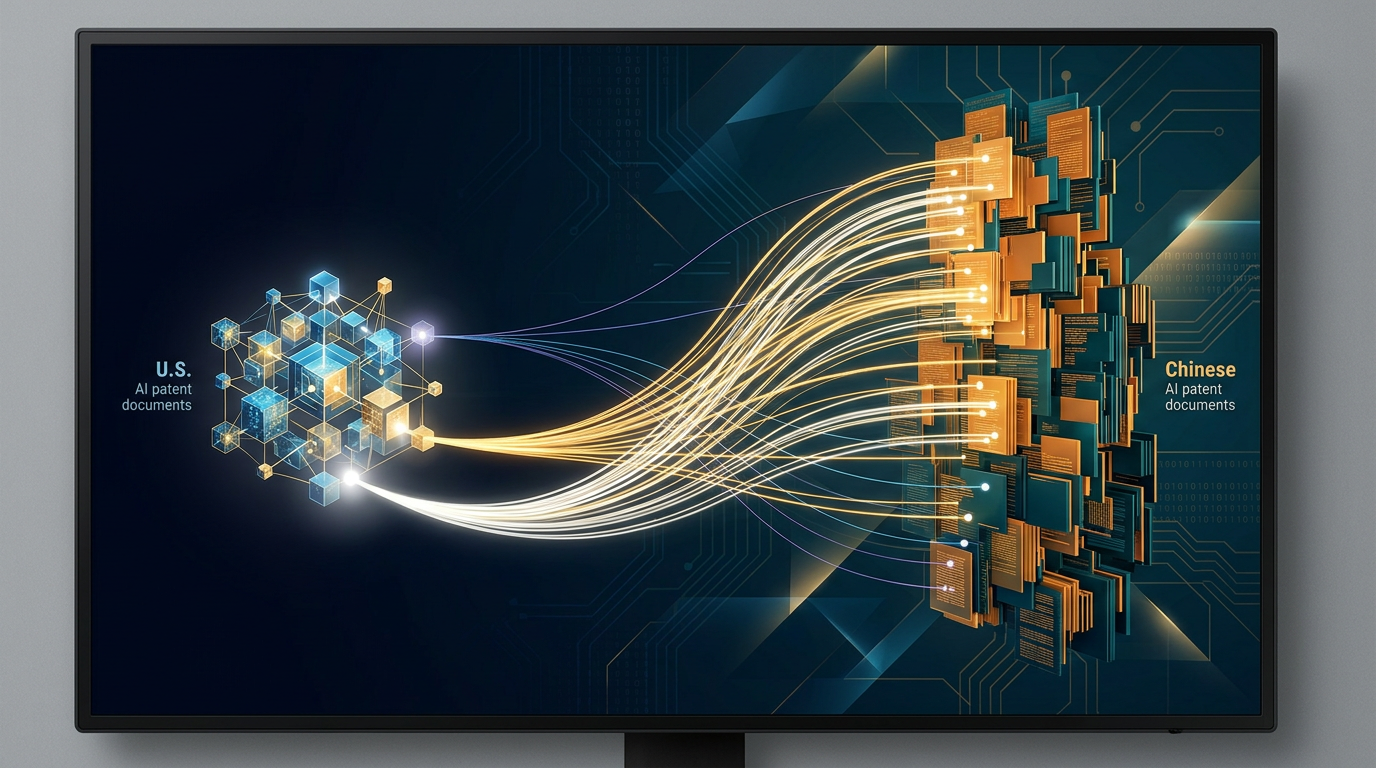
China is granting nearly four times as many AI patents as the U.S. each year, while citing American research at rates that reveal who still sets the technological frontier.
A recent NBER working paper by researchers from Penn, Durham, and Tsinghua delivers an interesting bilateral view of AI patents in the U.S. and China. The findings challenge conventional narratives on both sides.
By 2023, China granted 183,302 AI patents to the U.S.'s 48,197. AI's share of all patents has converged to ~20–21% in both countries. Volume favors China heavily.
Knowledge flows remain asymmetric. Chinese AI inventors cite U.S. patents far more intensively than U.S. inventors cite Chinese patents — and more intensively than China's non-AI inventors cite U.S. patents. This indicates China's AI sector still heavily depends on American frontier research.
Key Takeaways
- The USPTO's official AI classifier — the government's primary tool for tagging AI patents in its database — achieves only ~40% precision and 37.5% recall. The paper's new classifier reports a 97% precision and 91% recall. As a result, most official AI patent statistics and many prior-art searches have likely significantly undercounted the true scope of the field.
- U.S. AI patenting is dominated by IBM, Microsoft, and Google, concentrated in coastal clusters with limited diffusion since 2010. China's ecosystem is far more distributed — universities, state-owned enterprises (SOEs), and provincial clusters alongside Tencent, Baidu, and Huawei.
- AI patents carry a stock-market valuation premium over non-AI patents in both countries, including Chinese SOE and university holdings. Claims of limited economic value from China's surge are not supported by the market data. Chinese private firms cite SOE/university patents more than peer private ones.
- China's NLP patenting accelerated substantially after 2020, tracking commercial LLM growth. The generative AI wave is entering China's patent system faster than most appreciate.
What This Means for AI Companies and IP Counsel
For companies developing AI and their IP counsel: China is building a portfolio whose patents carry a clear stock-market valuation premium, built on state-backed upstream research that private firms actively commercialize, while absorbing U.S. frontier work. This positions U.S. patents as foundational assets — offering licensing upside but requiring proactive global monitoring and enforcement planning.
The open question is whether the U.S. patent system can continue protecting that frontier amid these asymmetric flows.