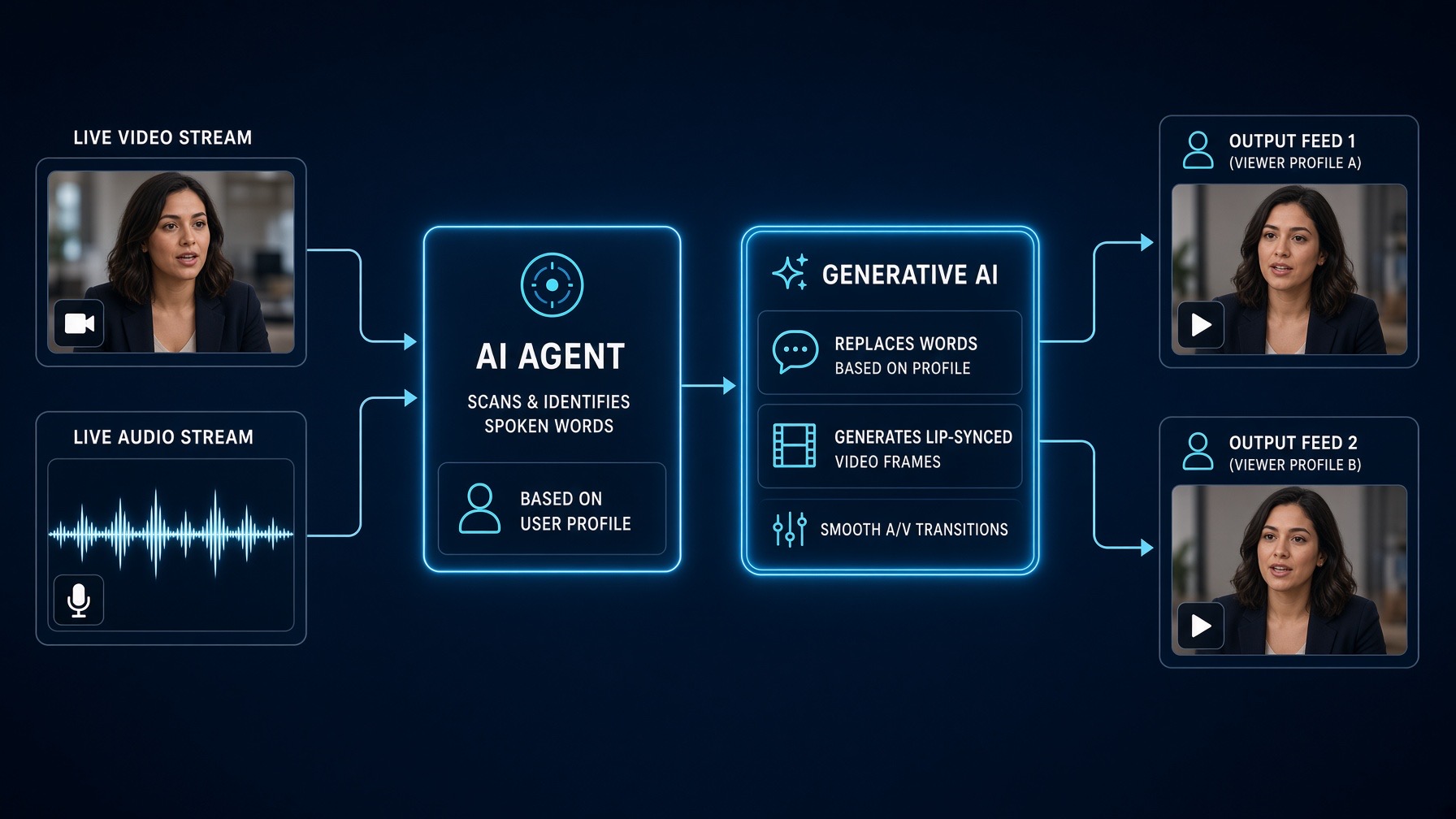
Microsoft is seeking a patent on AI that could show each viewer a different version of what a live speaker said.
Microsoft's published application describes "near-real-time" AI enhancement of video or augmented reality presentations of live events. An AI agent scans live video and audio and flags spoken words to modify. A generative AI system then swaps in replacement words, smooths the audio and video around each edit, and generates new video frames so the speaker's lips match. Replacement words can come from an Internet or database search of information on the topic under discussion. The application gives "instant fact-checking" as one example, in which AI systems search to verify what a speaker says in near-real-time and correct inaccurate or misleading information. Maggie Harrison Dupré reported on the filing for Futurism.
The uses described in the application range from live translation and removing filler words such as "um" to removing colloquial terms such as "y'all" and mumbled, mispronounced, misused, or misspoken words.
Claims and User Profile Personalization
Claim 1 requires the AI agent to select words "based on a profile of a user" and to edit both the live video and the live audio. Dependent claim 5 lists what the profile may hold, including age, spoken languages, region of birth, ethnicity, cultural background, and religion.
USPTO Obviousness Rejection and Claim Amendments
The examiner has rejected all 20 claims as obvious based on prior art publications, finding that a first publication (“Su”) describes selecting a target language from a user profile and adjusting the speaker's lips to match, and that a second (“Chiu”) suggests adding generative-AI lip manipulation and smoothed transitions. Microsoft since narrowed claims 1 and 15 to also require that the profile indicate "designated words to replace or remove," such as filler words and colloquial terms, and that words not on that list be left as the speaker said them. A dependent claim adds replacing offensive, insensitive, and inappropriate words. Microsoft also argued that the cited publications do not generate the new lip-synced video from already-smoothed replacement audio, as one independent claim, directed to live translation, requires.
Broader Implications for Deepfakes and Authenticity
Public debate over deepfakes has centered on fabricated footage spread to mislead. Microsoft's application describes a related technique, changing the words a speaker appears to say, driven by a viewer's profile, so a live event could be edited differently for each viewer. Rules on disclosure and authenticity for AI-edited live footage remain open questions for content publishers and regulators.
Sources
- Microsoft Technology Licensing, LLC, U.S. Patent Application Pub. No. 2026/0341309 A1 (filed Apr. 29, 2025; published Oct. 29, 2026): https://patents.justia.com/patent/20260341309
- USPTO Non-Final Office Action (July 29, 2026) and Applicant's Amendment & Response (Oct. 29, 2026), U.S. Appl. No. 19/193,093, rejecting claims over Su et al., US 2024/0430497, and Chiu et al., US 2024/0428827: https://patentcenter.uspto.gov/applications/19193093
- Maggie Harrison Dupré, Futurism (Nov. 1, 2026): https://futurism.com/artificial-intelligence/microsoft-patents-ai-words-in-peoples-mouths