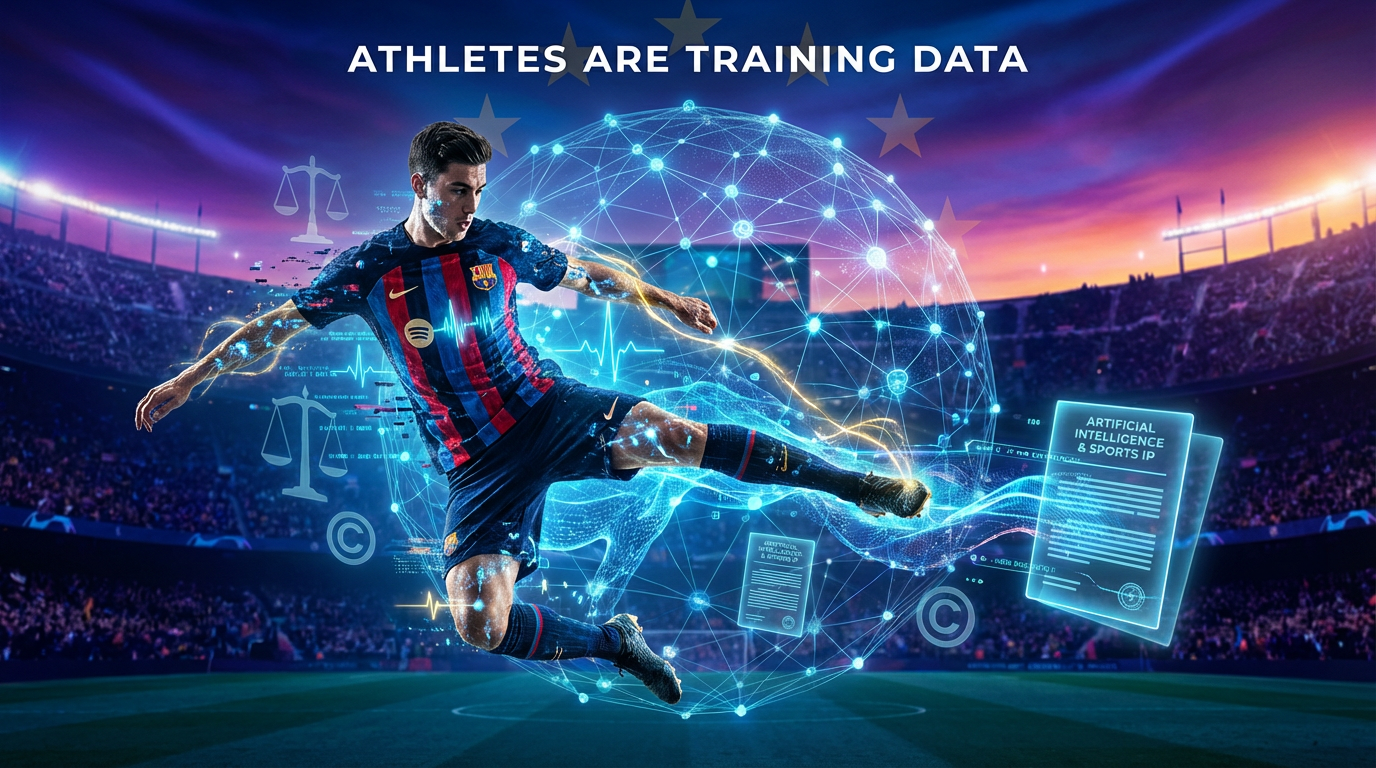
Callandor Group has unveiled what the company describes as the first dedicated registry for sports intellectual property in the AI era. The platform enables athletes and sports organizations to license their digital identities—likeness, movement patterns, voice, and biometric data—and to collect royalties when AI systems draw on those digital identities as training inputs.
CEO Michael Fisk frames the issue sharply: "Right now, the IP of a star like Lionel Messi or LeBron James is a legal Wild West. Their movements, voice and biometric data are being fed into AI models with zero transparency and no standardized royalty system."
For athletes, tech innovators, and their IP counsel on both sides, structural challenges are becoming apparent:
Key Legal and Structural Challenges
- ⚖️ Copyright Limitations: Raw movement patterns and biometric data are generally treated as uncopyrightable factual information under U.S. copyright law (see Feist Publications, Inc. v. Rural Tel. Serv. Co., 499 U.S. 340 (1991)). Athletes instead rely primarily on state-law rights of publicity (especially strong in California) and contractual name, image, and likeness (NIL) protections. Who owns—or can license—these inputs when used to train generative models?
- 📋 Operationalizing Licensing: How do these data creators operationalize a licensing and royalty framework when no standardized tracking system exists for AI queries? Callandor's Event Horizon API and registry aim to fill that specific gap.
- 🌍 Regulatory Pressure: The EU AI Act, with phased transparency obligations for general-purpose AI models taking effect August 2026, and California's emerging transparency legislation are already creating compliance pressure. Platforms like Callandor's registry position themselves as the commercial infrastructure layer that makes regulatory adherence scalable and profitable.
- 🏟️ Initial Market Focus: European soccer is an initial target market, with reported working relationships already in place with FC Barcelona's digital arms (Barça Media, Barça Digital Assets).
The pattern is familiar across creative industries: when human performance becomes AI training data, traditional IP doctrines strain. Courts and regulators are catching up, but market-driven solutions are arriving first—betting that standardized licensing will become table stakes.
Read more by Naman Ramachandran from Variety here: https://lnkd.in/ex8buwZU