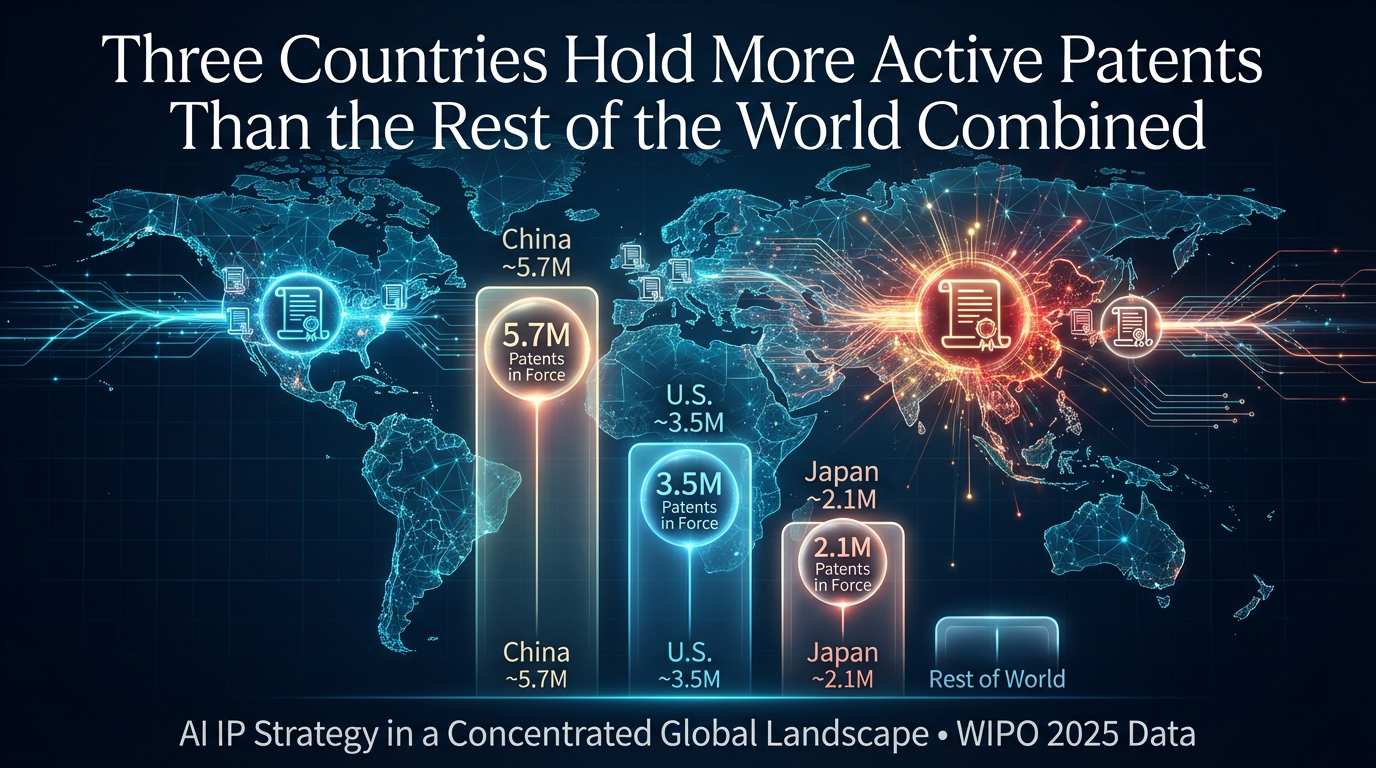
Latest WIPO data on patents in force (2024, as reported in the 2025 World Intellectual Property Indicators) shows China with approximately 5.7 million, the U.S. at 3.5 million, and Japan at 2.1 million. Together, these three jurisdictions hold more than the remaining ~8.4 million patents in force across all other countries worldwide (global total: 19.7 million).
For AI innovators and patent practitioners, the numbers that matter most:
- China's lead over the U.S. exceeds 2.17 million patents and continues to grow rapidly (+14% in patents in force in 2024 alone). China also accounts for the majority of global AI patent applications in recent years (estimates range from 60%+ overall AI to even higher shares in generative AI), previewing where many foundational AI IP disputes, licensing negotiations, and enforcement actions will likely center in the coming decade.
- South Korea stands out at 1.31 million active patents. For the size of its economy, this density reflects a deliberate national strategy that has propelled leadership in semiconductors, batteries, and AI technologies.
- Germany leads Europe with 963,941, but the drop-off is steep (France ~757k, UK ~744k). This concentration underscores the growing value of the EU's Unitary Patent system — now seeing uptake rates of ~28–40% among European patentees and higher among SMEs — for efficient, cost-effective multi-country protection across up to 18 participating Member States.
Global innovation remains heavily concentrated in a handful of jurisdictions. For companies developing AI technologies, this reality demands sophisticated, jurisdiction-specific patent strategies — balancing high-volume filings in high-growth markets with quality-focused protection and enforcement planning in commercially important venues.
How are you adapting your AI patent filing and portfolio strategies to this shifting global landscape?
View the data and read more by Tasmin Lockwood from Visual Capitalist here: https://lnkd.in/eXA3iSA8