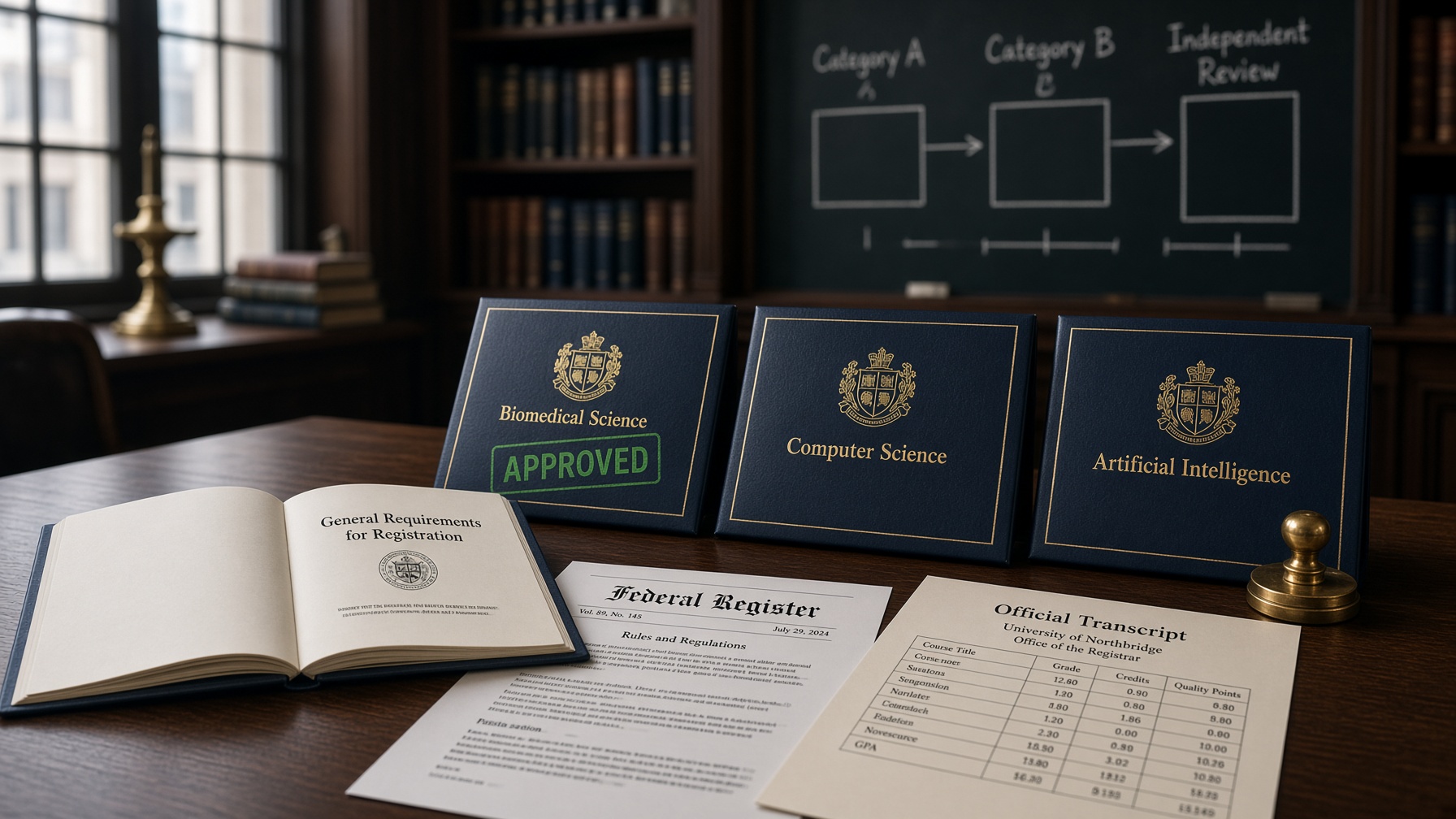
The USPTO has updated its patent bar admission criteria — and declined to add AI as an automatic qualifying degree.
A qualifying science or engineering degree, or a minimum amount of such coursework or equivalent practical experience, is required for admission as a patent practitioner before the USPTO. On August 11, the Office updated these requirements, publishing a Federal Register Notice (91 FR 51695) moving Biomedical Science from Category B to Category A of the General Requirements Bulletin (GRB). Thus, a Biomedical Science degree now satisfies the scientific and technical requirement without additional coursework documentation required for Category B degrees.
This is the first output of the three-year review cycle the USPTO committed to in May 2023 (88 FR 31249). The 2021 review moved 14 degrees into Category A. The current one moved just a single degree.
Why AI Degrees Were Not Added
AI degrees were considered and not added. There was no indication that degrees in AI technology are disqualifying, but rather that there is insufficient data on these degrees, noting:
- Over the past three calendar years, one applicant held an Applied AI degree and none held a standalone AI degree
- Most institutions do not yet award the degree
- Programs being implemented vary in scope and complexity, and include many non-technical courses
For example, Purdue University offers three AI degrees: a BS in AI, a BS in ECE with an AI concentration, and a BA in AI run by its Philosophy department — similar degree names covering substantively different coursework.
The Office committed to continue monitoring. If an AI degree is determined to be equivalent to a Bachelor of Science in Computer Science, it may be considered under Category A.
Clarifications on the Notice
- Category A is expressly non-exhaustive. An AI degree can still qualify an applicant for the patent bar through Category B, through transcript-based equivalency to a listed Category A subject, or through independent review under 37 CFR 11.7(a)(2)(ii).
- The one-applicant figure measures degree nomenclature without regard for capability. Computer science, computer engineering, and electrical engineering graduates with a machine learning concentration already sit in Category A and thus do not appear in this "AI degree" count. The population of technically AI-fluent candidates is far larger than the count suggests.
Looking Ahead
The next review is expected in three years. Whether AI degrees will move up to Category A depends on university standardization and an Office finding of equivalence to technical degrees like computer science. Until then, aspiring patent attorneys should pursue conventional technical degrees involving AI coursework, or be prepared to show equivalency or qualifying practical experience.
Sources
- Reporting by Rose E. in IPWatchdog, Inc: https://ipwatchdog.com/2026/08/12/uspto-expands-category-a-patent-bar-admission-criteria-to-include-biomedical-science-degree/
- Federal Register Notice, 91 FR 51695 (Aug. 11, 2026): https://www.federalregister.gov/documents/2026/08/11/2026-16315/administrative-updates-to-the-general-requirements-bulletin-for-admission-to-the-examination-for
- Purdue's BA in AI requires 24 credit hours in philosophy and 15 in computer science: https://cla.purdue.edu/academic/philosophy/students/undergraduate/majors/artificial-intelligence/index.html
- Prior cycle notices: 88 FR 31249 (May 16, 2023); 86 FR 52652 (Sept. 22, 2021).