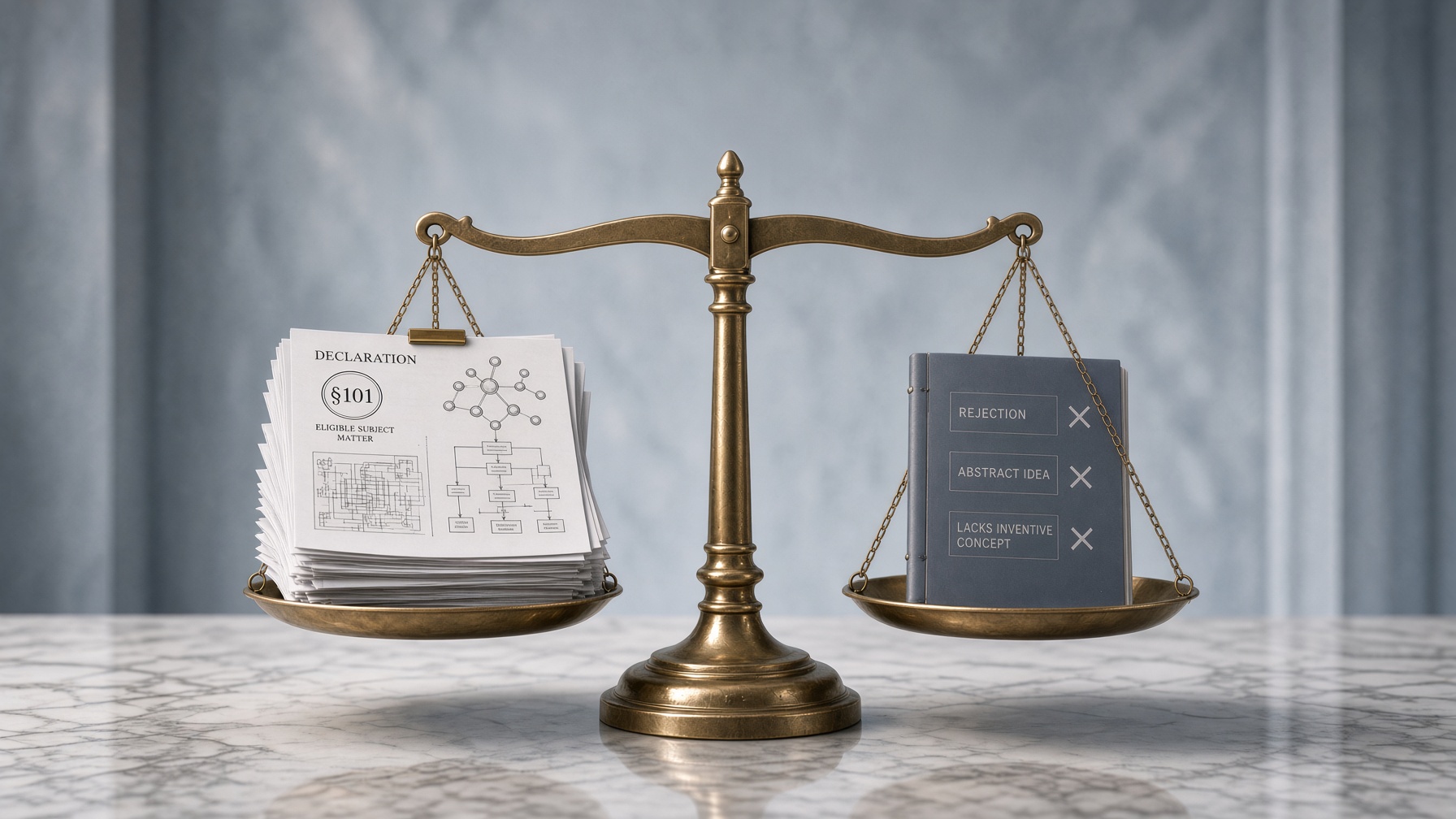
The USPTO offers guidance to examiners and applicants on how patent eligibility declarations are weighed as evidence.
In The National Law Review, Michael Shepherd of Bradley Arant Boult Cummings LLP analyzes the September 29, 2026 memorandum and flowchart from the U.S. Patent and Trademark Office (USPTO) for Subject Matter Eligibility Declarations (SMEDs), the declarations applicants file as evidence of patent eligibility under 35 U.S.C. §101.
Three Threshold Tests from the MPEP
Under the flowchart, the examiner applies three threshold tests drawn from the Manual of Patent Examining Procedure (MPEP):
- Proof of an eligibility-relevant fact. An expert's statement that "claim 1 is patent eligible" is a legal conclusion. Testimony on how the technology works, what the technology improves, or why a step is impractical to perform mentally is evidence.
- Nexus to the claim. A proffered fact needs a connection to features the claim recites. An improvement attributed to an unclaimed feature carries little to no weight.
- Consistency with the original disclosure. An SMED may explain the disclosure but may not introduce undisclosed features years after the application filing.
Weighing the Evidence
Shepherd's principal point concerns weighing of the evidence. MPEP §716.01(d), citing the Federal Circuit's decision in In re Eli Lilly (1990), directs the examiner to weigh rebuttal facts against the evidence supporting the rejection, "not against the conclusion itself." In Shepherd's view, an examiner without contrary literature, an applicant admission, or an identified flaw in the expert's reasoning may have no evidence to weigh, and disagreement with an expert is not contrary evidence. The flowchart also states that a rejection is proper only if ineligibility is more likely than not, with a 50/50 split decided for the applicant.
The USPTO states that the memorandum "does not announce any new USPTO practice or procedure." Eligibility remains a legal conclusion, so a proven fact does not by itself compel allowance, and the examiner still must make threshold findings on probative value, nexus, and supplementation.
Empirical Findings and Prosecution Strategy
In a study of 460 eligibility declarations on the patent blog Patently-O, Dennis Crouch found that, where the next Office action was on record, about 25% of applications received an allowance, about 9% saw the §101 rejection withdrawn, and about 66% received the same rejection again.
A declaration can prove what the specification already describes and tie the proof to features the claims already recite, so the evidentiary record for eligibility is largely established when the application is drafted. An SMED should also be drafted with the understanding that every statement can be used against the patent owner in litigation.
Sources
- Michael P. Shepherd, "USPTO SMED Update: What Does It Mean to 'Weigh' Evidence of Patent Eligibility?," The National Law Review (Oct. 5, 2026): https://natlawreview.com/article/uspto-smed-update-what-does-it-mean-weigh-evidence-patent-eligibility
- USPTO, Subject Matter Eligibility Declarations (SMEDs) under 37 CFR 1.132: Flowchart for Analysis and Best Practices (Sept. 29, 2026): https://www.uspto.gov/sites/default/files/documents/smeds-memo-20260929.pdf
- USPTO SMED evaluation flowchart: https://www.uspto.gov/sites/default/files/documents/smeds-flowchart.pdf
- In re Eli Lilly & Co., 902 F.2d 943 (Fed. Cir. 1990); MPEP § 716.01(d): https://www.uspto.gov/web/offices/pac/mpep/s716.html
- Dennis Crouch, Patently-O empirical study of SMEDs (Oct. 13, 2026): https://patentlyo.com/patent/2026/10/subject-matter-eligibility-declarations-an-empirical-study-of-rule-132-evidence-and-examiner-response.html