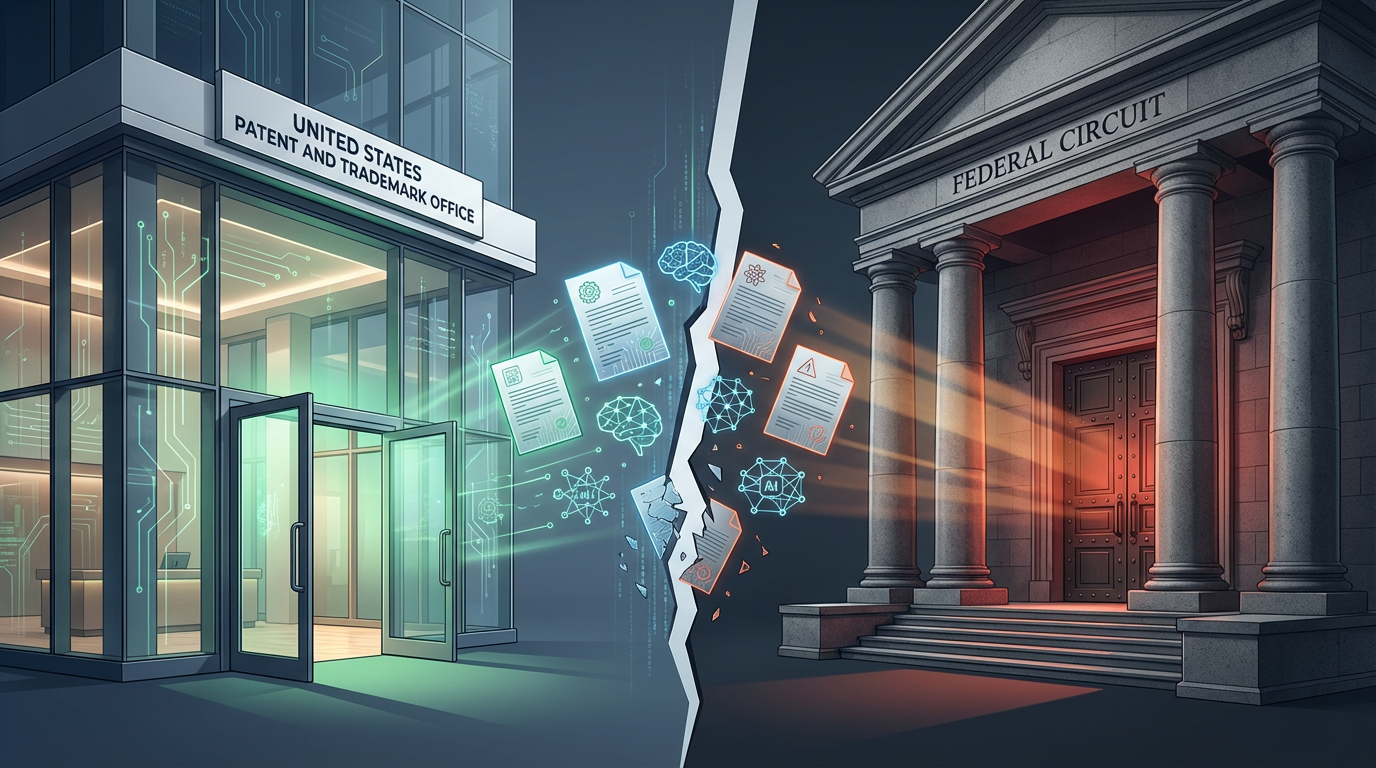
The USPTO has shifted on AI patents. The courts have not. That gap is where portfolios become vulnerable.
The past six months have brought more favorable examination conditions for AI patent applicants than practitioners have seen in years. Director Squires' August 2025 memo, the precedential Ex parte Desjardins decision (now binding on examiners and PTAB), and December 2025 Subject Matter Eligibility Declaration (SMED) guidance have all moved in the same direction. Technology that was too abstract to pursue eighteen months ago may now have a viable path to protection.
But A.J. Tibbetts at Greenberg Traurig offers a timely warning in Massachusetts Lawyers Weekly: the USPTO and the courts are not moving together, and companies that mistake one for the other will build portfolios that look strong until they are tested.
The Federal Circuit has not changed course. Recentive Analytics (April 2025) made that plain, invalidating four AI patents that applied generic machine learning techniques to broadcast scheduling without explaining how the models themselves were improved, what distinguished the implementation from conventional techniques, or how the technology advanced the model or technical field (per longstanding Enfish/McRO precedents that Desjardins itself applies).
What This Means Practically
- ⚖️ A patent granted under today's more receptive examination can still be invalidated under the same Alice/Mayo framework the Federal Circuit applied in Recentive.
- 📋 SMEDs are a powerful prosecution tool to build an evidentiary record of technical improvement, but they are not a substitute for applications drafted with specific technical improvements disclosed from day one.
- 🌍 The UK Supreme Court's Emotional Perception decision (Feb. 2026) lowers the UK eligibility bar (aligning closer to EPO), shifting scrutiny to novelty and inventive step and creating potential divergence for global portfolios.
- 🔍 Companies whose counsel previously advised against filing certain AI applications, or who pursued narrower claims than the technology supported, now have a genuine window to reassess.
The article's core point is the right one. The current environment at the USPTO presents an opportunity, but not without potential risks in litigation. Claims need to recite mechanisms (how the model is improved or the technical field advanced), not merely describe outcomes. Specifications should explain the specific technical contribution—exactly what Desjardins and Recentive both demand, albeit with potentially different results at the USPTO versus in court.
The result is a bifurcated landscape: easier grants at the USPTO, but patents may face heightened scrutiny in court under the Federal Circuit's unchanged insistence on technical specificity. Portfolio audits with AI-experienced counsel are now essential.
Read more here: https://lnkd.in/eQ7RJTUv