My first Christmas present I remember as a kid was the original NES system. It was a big deal for me, as well as my friends and family. So this ongoing Nintendo case hits particularly close to home.
Global AI-related patent grants and filings have accumulated rapidly, surpassing hundreds of thousands by 2025, with China leading at around 70% (per the Stanford AI Index 2025 Report). Legal battles over AI and tech IP are intensifying, especially in gaming.
The Nintendo v. Pocketpair Case
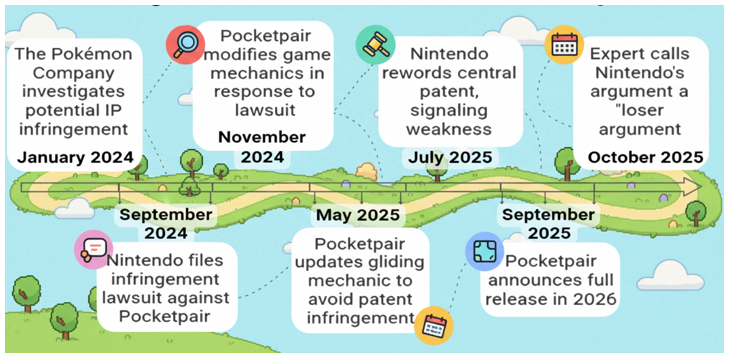
The high-profile Nintendo v. Pocketpair case (ongoing in Japan as of late 2025) illustrates the stakes:
Nintendo and The Pokémon Company allege that Palworld infringes patents on mechanics such as throwing a ball-like device to capture creatures, riding the captured creatures as mounts, and seamlessly switching between different ridable creatures.
Pocketpair is defending vigorously—challenging patent validity with prior art, implementing gameplay updates to avoid potential infringement, and arguing that such general mechanics shouldn't be patentable.
The outcome could influence IP protection for game mechanics, with broader implications for innovation in gaming (including AI-assisted game development).
Implications for Tech Innovation
These disputes are shaping the rules of creativity in tech. Companies must document innovations carefully, anticipate patent challenges, and build robust IP strategies.
How should patent systems balance incentivizing innovation while preventing overbroad claims that monopolize core game mechanics or computational techniques?
This was a fun read on Lexology from Rajendra Singh and Abhay Porwal from Nishith Desai Associates: https://lnkd.in/esigs5FN