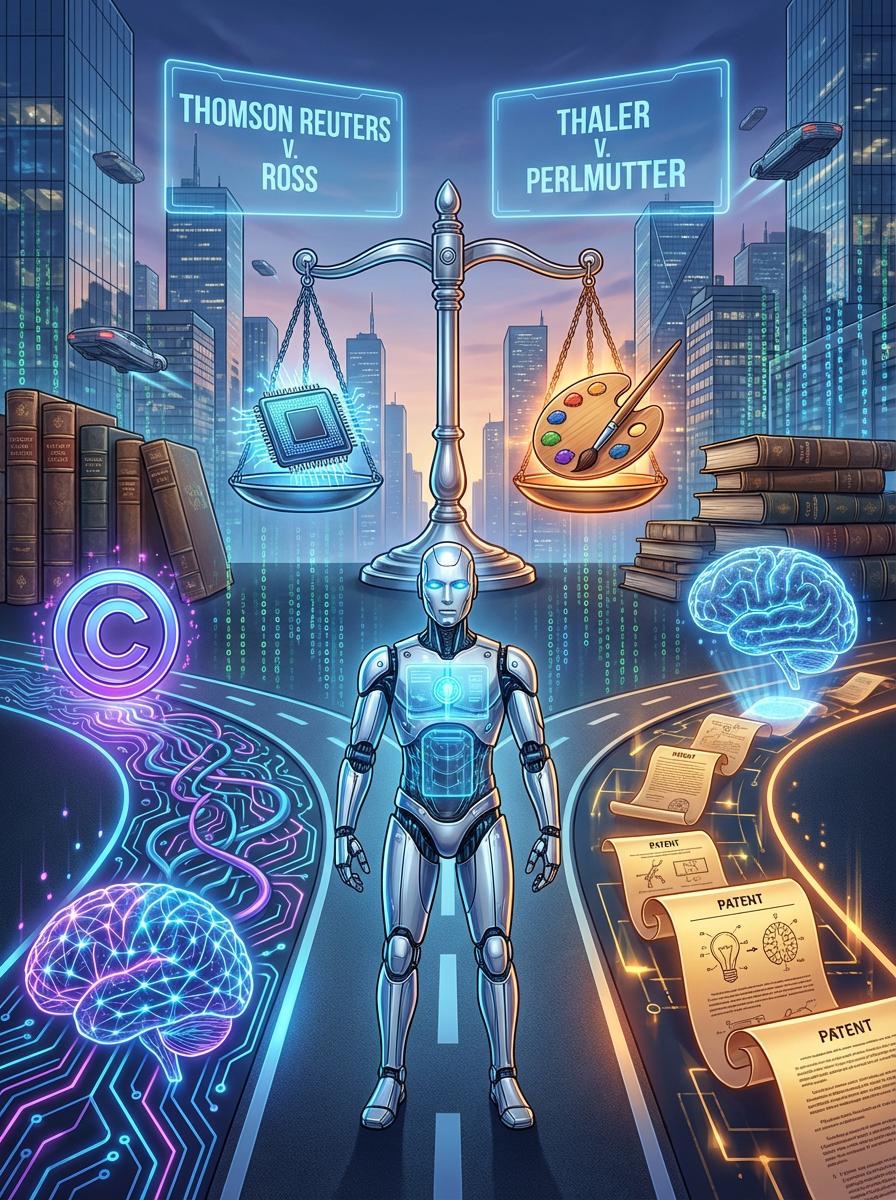
What once felt like futuristic satire now frames a very real IP inflection point.
In Copyright and AI: The Battle for the Future, Nyasha Foy, Esq., Temidayo "Dayo" Akinjisola, Esq., and James Parker for New York State Bar Association, explore AI's collision with copyright in recent cases (e.g., Thomson Reuters v. Ross Intelligence; Kadrey v. Meta). https://is.gd/74T0ex
Shifting Risk, Value, and Leverage for IP Lawyers
- Training data is the most contested IP asset, highlighting input ownership and licensed use to avoid infringement (e.g., Bartz v. Anthropic, $1.5B settlement).
- Courts highlight market substitution and licensing harm, focusing on transformative purpose vs. economic impact (Thomson Reuters).
- Human authorship remains the anchor, but only with careful documentation, requiring human contribution (Thaler v. Perlmutter, no copyright for AI-only works).
- Licensing offers opportunity, but poor deals could redefine ownership and competition, with risks in AI outputs/derivatives (e.g., data, derivatives, non-competes in Disney-OpenAI).
Universal IP Principles: Copyright and Patent Parallels
These challenges reveal universal IP principles analogous to AI disruption in patents:
Human-Centric Creation
Copyright demands human authorship with documentation (e.g., creative process videos in A Single Piece of American Cheese registrations); patent law insists on human inventorship—AI cannot be inventor, standards unchanged with assistance (USPTO Inventorship Guidance, Nov 2025; DABUS rejected by USPTO/UKIPO/EPO, 2019–2024), needing human conception proof.
Transformative Use vs. Harm
Copyright fair use balances innovation against substitution; patents parallel this in §101 eligibility, requiring AI inventions to integrate applications avoiding rejection as "abstract ideas" (Alice Corp. v. CLS Bank), with guidance on emerging AI tech (USPTO Subject Matter Eligibility Update, July 2024).
Ownership and Licensing
Copyright disputes over training data and outputs echo patent concerns with algorithms, datasets, and AI-assisted innovations—licensing must clarify joint ownership and improvements to prevent disputes. In AI/tech-traditional industry partnerships for business improvements (e.g., Microsoft with Advocate Health for AI documentation tools or AWS with Audi for AI welding inspection), substantial risks involve data leakage through model memorization, vendor reuse of refinements trained on proprietary data, infringement of unlicensed inputs/processes, and ambiguity over foreground (new) vs. background (pre-existing) IP, leading to lock-in/disputes. Best practices include explicit contracts defining ownership of AI-generated outputs and improvements, data firewalls/deletion rules, infringement indemnities, and survival clauses.
The Reality Check
The Jetsons promised frictionless efficiency. The reality: new tech, old doctrines, fast-closing window to shape norms before precedent hardens.
As AI reshapes IP, legal frameworks must adapt to sustain human creativity, invention, and commercialization.