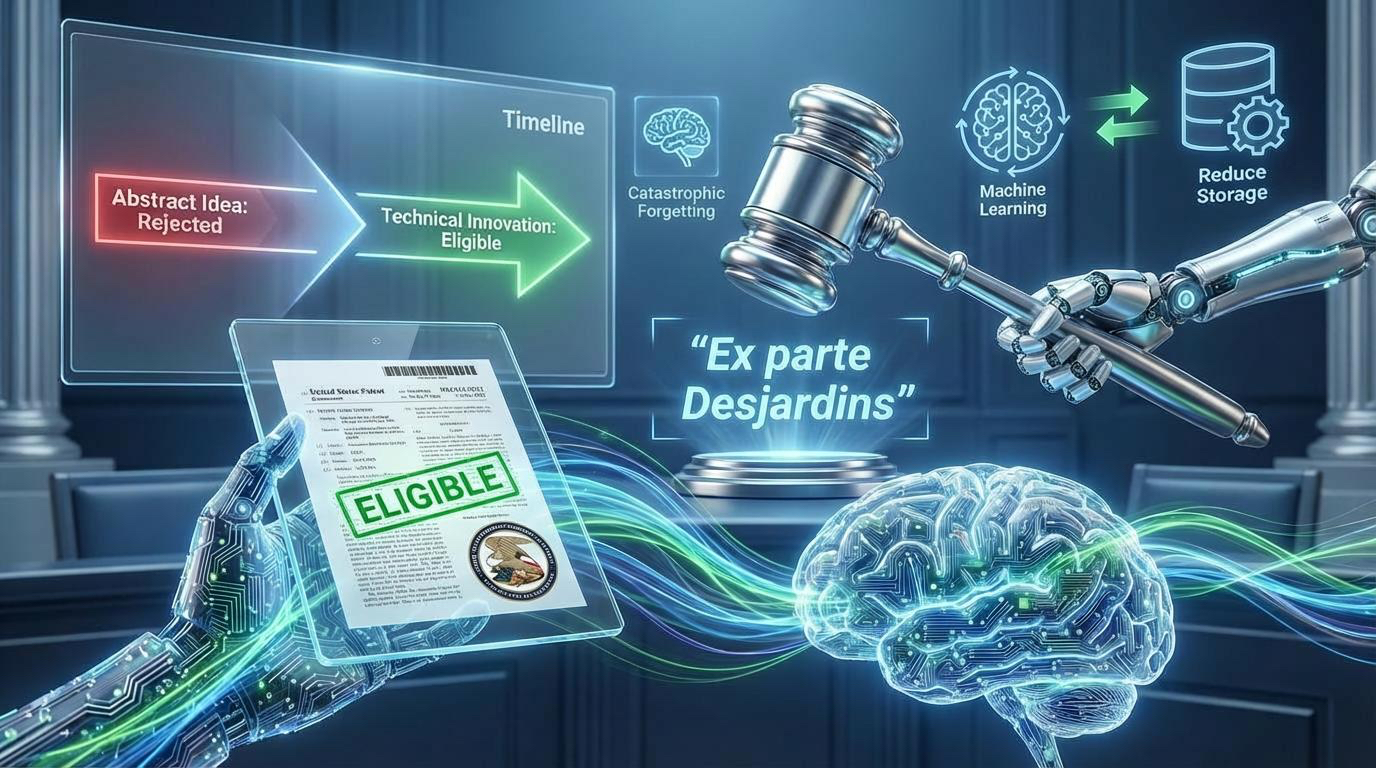
AI patent eligibility has evolved at the USPTO, with one precedential case at the heart of the shift.
In an insightful Bloomberg Law article, Matthew Carey recaps the Ex parte Desjardins decision and the USPTO's guidance on subject matter eligibility of AI inventions.
Carey's analysis highlights the Sept. 26, 2025, Appeals Review Panel decision authored by Director John A. Squires. Designated precedential and later integrated into the Manual of Patent Examination Procedure (MPEP), the decision vacated a rejection of claims for training a machine learning model on multiple tasks.
The invention at issue used a single model to approximate posterior distributions for parameter importance and applied a penalty term during optimization, preventing “catastrophic forgetting,” boosting efficiency, reducing storage, and simplifying the system.
The panel found the claims recited a patent-eligible practical application under precedents like Enfish, LLC v. Microsoft Corp., 822 F.3d 1327 (Fed. Cir. 2016) (data structure claims to a self-referential table for a database held eligible as improving computer functionality). Desjardins thus marks a move away from reflexive rejection of claims as “abstract” and toward evaluating technical contributions.
Desjardins has been applied to find AI claims patent eligible in cases like Ex parte Carmody, Appeal No. 2025-002843 (P.T.A.B. Dec. 30, 2025) (modular ML architecture with plug-and-play models held eligible for improved operational efficiency).
Read Carey's full piece: https://lnkd.in/e76n-ZZ4.
Drawing from these developments, Desjardins empowers AI innovators by emphasizing evaluation of concrete operational improvements in patent claims. But patent eligibility requirements aren't eliminated entirely, and obviousness rejections remain key hurdles. (See my recent newsletter article discussing AI's impact on obviousness analysis.)
As discussed in more detail in my prior post on USPTO memoranda elevating Subject Matter Eligibility Declarations (SMEDs): https://lnkd.in/e4VxHnkF, SMEDs were highlighted following Desjardins as another tool to overcome eligibility rejections—using evidence like expert testimony or data reviewed under a preponderance standard. Since Desjardins, the USPTO's more patent-friendly treatment of AI innovations aims to bolster US tech leadership amid global competition.